

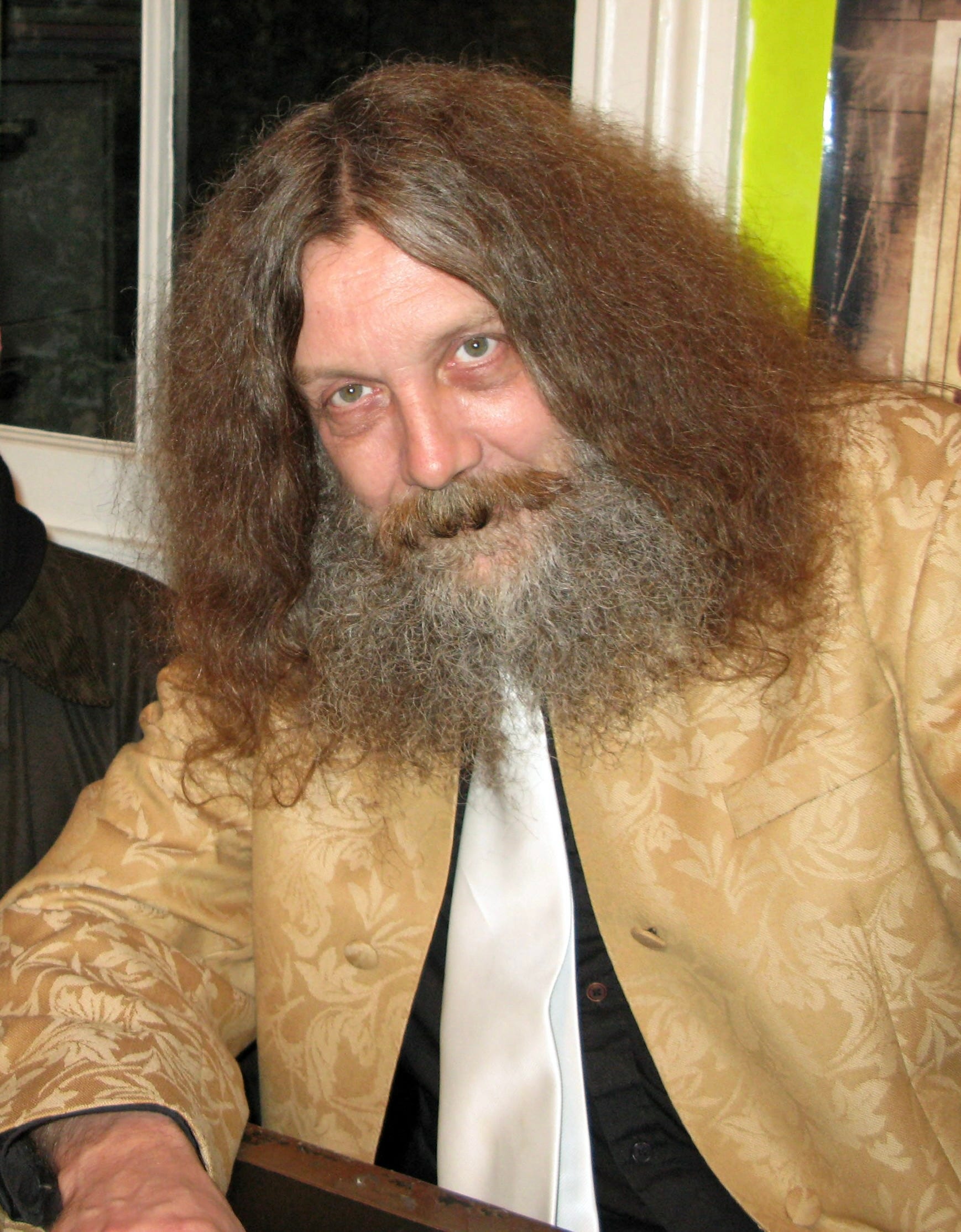
Talking with Alan Moore is a little like stumbling into one of his books. A straightforward question about a fantasy novel can suddenly open onto London’s hidden history, psychedelic music, magic, artificial intelligence, or the fate of human civilization. The celebrated author of the graphic novels Watchmen, V for Vendetta, From Hell, Promethea, and The League of Extraordinary Gentlemen remains one of the most original thinkers in contemporary literature, and his ambitious new five-volume fantasy cycle, Long London, may be his most expansive project yet.
The second installment in the series, I Hear a New World, recently arrived on bookshelves, following 2024’s The Great When. Speaking with KC Arts Beat, Moore explained that the title Long London reflects his desire to see the city not as a single moment in time but as an entire continuum.
“We tend to only see the present moment,” Moore said. “I thought it might be better to look at things with a longer view, to take into account all of London’s history, and all of the strange characters that it’s seen, many of whom have been forgotten.”
The “Great When” is Moore’s name for a secret London existing alongside the familiar one, a city formed from forgotten histories, unrealized possibilities, dreams, stories, and fragments of the past. It embodies the central idea of the Long London novels: that the past never truly vanishes, but remains mysteriously present beneath the surface of everyday life.
“To see an entire city,” he said, “with a long view, so that all of the times of London, past, present, and future, are all somehow happening at once.”
The first novel is set in 1949, in a London still scarred by World War II. Moore described the city as a kind of blank slate after the Blitz, physically and psychologically transformed by years of conflict. The second novel moves forward roughly a decade, to the end of the 1950s, a period when Britain was on the threshold of enormous cultural change.
That shift led Moore toward one of the book’s most fascinating presiding spirits: the visionary music producer Joe Meek.
For many listeners, Meek is best known as the producer behind the 1962 instrumental hit “Telstar.” But Moore sees him as a vastly more important figure whose influence on modern music has never been fully appreciated.
“He had, more or less, invented the modern music industry,” Moore said.
The Tornados Telstar 1962
Moore became deeply interested in Meek decades ago while researching a performance project in London’s Highbury neighborhood, where the producer lived and worked. What he discovered was a brilliant but troubled innovator whose experiments reshaped recording technology.
“The tangle of wires over Joe Meek’s studio floor,” Moore said, became the inspiration for later recording consoles and effects systems. “All of these effects that we take for granted now, it was Joe Meek who invented all of them.”
The producer’s life also contained a strain of the uncanny that fits naturally into Moore’s fictional universe. Meek reportedly attended séances and became fascinated with supernatural subjects. Moore notes in the novel that Meek predicted Buddy Holly’s death, albeit a year before it actually occurred.
“All of this stuff really happened,” Moore said. “And so I thought it was irresistible to work it into a London fantasy.”
The title I Hear a New World comes from Meek’s remarkable and long-neglected 1959 concept album of the same name. Listening to the album today is a startling experience. Its electronic sounds, altered voices, and dreamlike atmosphere seem to arrive from another decade entirely, anticipating psychedelic music before the psychedelic era officially existed.
Moore agrees.
“Nobody was interested in it,” he said. “It was his pet project that he was really enthusiastic about. But in 1959, nobody could understand it.”
Yet Moore believes the album’s influence may have been far greater than history has acknowledged.
“If it hadn’t been for that album, if it hadn’t been for this new musical sensibility that Joe Meek had introduced to the world, there might not have been a psychedelic movement,” he said. “There were other factors, but I think that Joe Meek was a very, very big factor that has probably been forgotten.”

The psychedelic thread will become even more pronounced as the series progresses. Moore has already completed the third volume, Blow Away Dandelion, which moves into the late 1960s. The fourth installment, In England’s Dreaming, will explore the punk era of the 1970s. A final volume will leap ahead to the eve of the millennium in the 1990s.
“There are five novels in the series,” Moore said. “I am talking about the last 50 years of the previous century to try and help people understand, and to help myself understand, how we ended up in our current century.”
In other words, the fantasy elements are only part of the project. Beneath them lies an attempt to understand the forces that shaped the modern world.
“I want to put a spotlight upon the path that led us here, and see if I can draw any conclusions.”
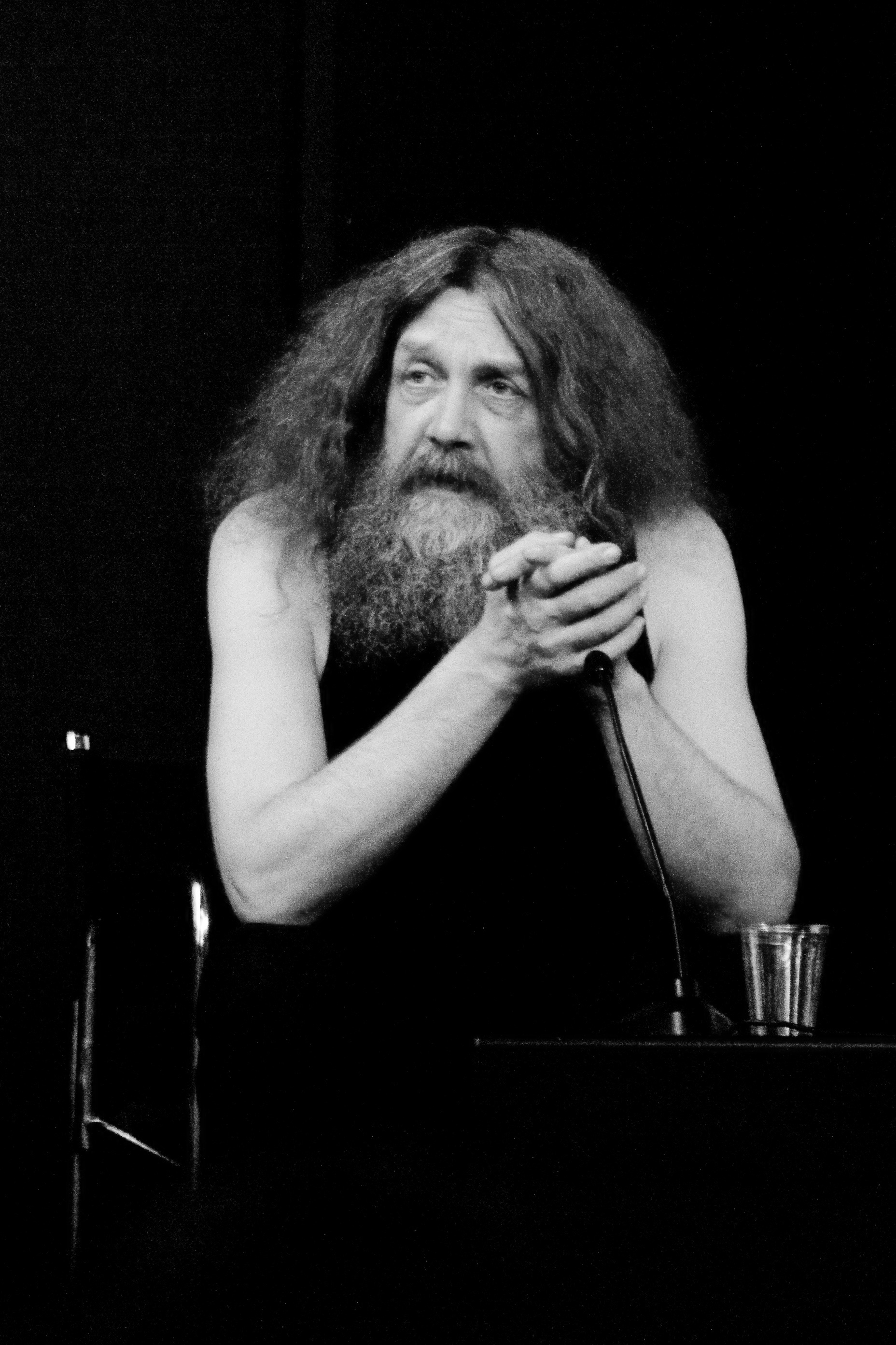
That conversation naturally led to the present moment and Moore’s thoughts on artificial intelligence, a subject about which he remains notably skeptical.
Years ago, Moore described modern culture as “turning to steam,” a metaphor he revisited during our discussion. Like water changing state, he believes humanity is passing through a major cultural transition driven in large part by the internet and new forms of connectivity.
“The way in which we are connected now as individuals is very, very different to the way that we used to be connected,” he said. “It has made human relationships different. It has made almost everything about human society different.”
Artificial intelligence, in his view, is merely one consequence of that broader transformation.
“AIs are probably a part of this process,” he said. “But frankly, I’m not that impressed with AIs.”
Moore readily acknowledges practical applications in medicine and scientific research. But he questions whether many of the technology’s current uses justify the enormous resources devoted to it.
“Helping us to compose an email?” he asked. “An immense technology, a very expensive technology, to help us do something that we could probably do ourselves if we were to just make a little bit more effort?”
For Moore, the deeper issue is consciousness. Throughout his career he has frequently described language and art as forms of magic, not in the stage-magician sense, but as transformative acts capable of reshaping human awareness. Artificial intelligence, he argues, lacks the conscious spark that gives art its meaning.
“I think that art is magic,” he said. “And I would say that what an AI produces is neither.”
Moore returned to one of his most intriguing ideas: that language itself is the foundation of human consciousness.
“We are made of language,” he said. “And if you can manipulate that language, if you can change that language, you can change people’s consciousness.”
He pointed to George Orwell’s observation in 1984 that limiting language limits thought itself.
“If you limit people’s use of language, you’re limiting their intelligence, their consciousness, what they can think about,” Moore said. “But I would say that the reverse is also true. If you expand people’s knowledge of language, if you expand their vocabularies, then that will empower them.”
For a writer whose career has been devoted to expanding literary possibilities, the comment felt less like a theory than a mission statement.
And despite his clear-eyed assessment of present-day problems, Moore remains surprisingly optimistic about the future.
“Pessimism is useless,” he said.
Human history, he argues, consists of a series of profound transitions, from hunter-gatherer societies to agriculture, from agriculture to industry, and now from the industrial age to something new. Change can be disruptive and frightening, particularly for those invested in older systems, but Moore believes it is ultimately unavoidable.
“I think that we can see a new future coming,” he said.
That’s an observation that could easily belong in one of the Long London novels themselves: a recognition that history is never static, that past and future are always colliding beneath the surface of the present moment. Moore’s new series explores that collision through fantasy, myth, and hidden histories. But beneath the magic lies a serious question that has animated his work for decades:
How did we get here, and where are we going next?
The answers, if Moore has his way, will unfold one decade at a time.


