

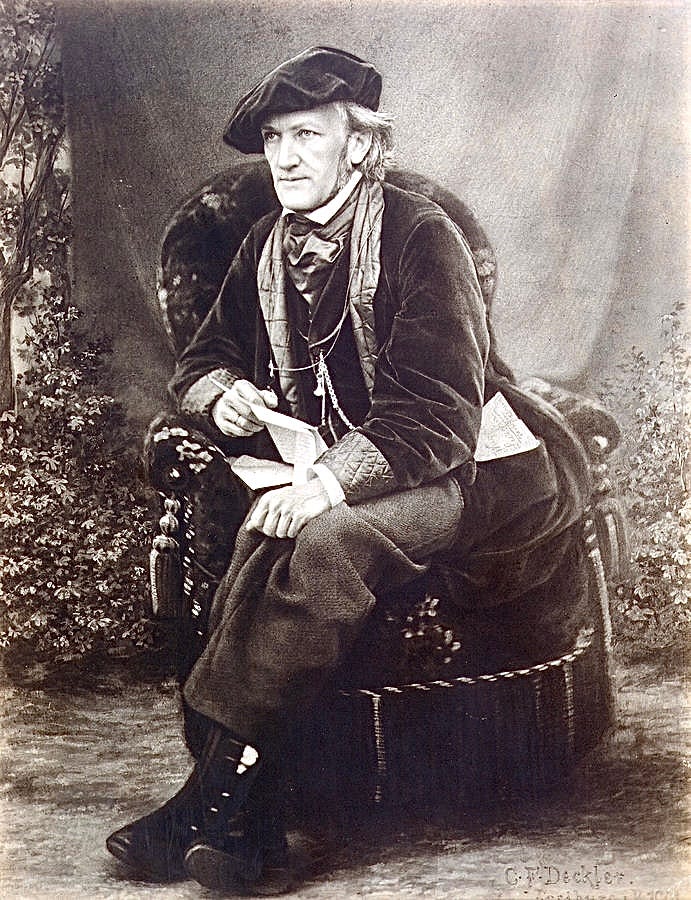
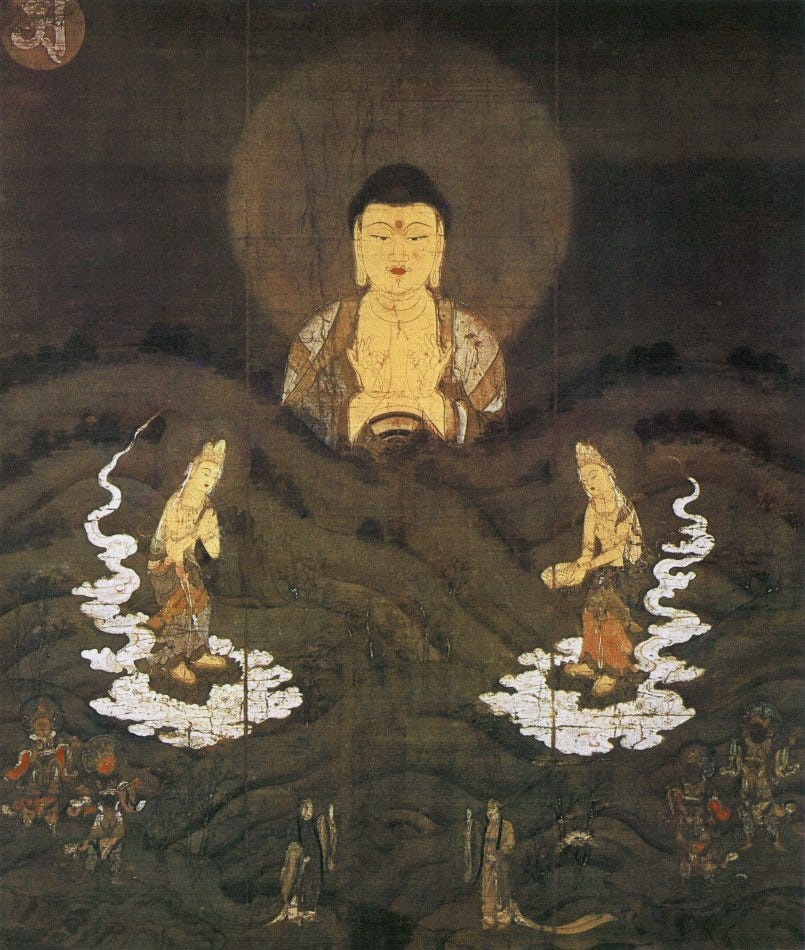
You might find it hard to believe that the 19th century German composer Richard Wagner, the same composer who wrote Tannhäuser, The Ring of the Nibelung and other operas based on Teutonic mythology, was also drawn to Buddhism, but it’s true.
There’s a lot to unpack here.
Buddhism entered Europe in the nineteenth century through a patchwork of philology, Orientalist curiosity, and Romantic projection. Scholars like Eugène Burnouf in France and the German-born Max Müller in Britain introduced Europeans to Buddhist texts through pioneering (if imperfect) translations, while travelers, missionaries and colonial administrators brought back reports that mingled genuine observation with exoticism. At the same time, poets, philosophers and artists, from the French Symbolists to the Transcendentalists, seized on Buddhism as a mirror for their own spiritual longings, often reshaping it into something dreamlike, pessimistic, or metaphysical.
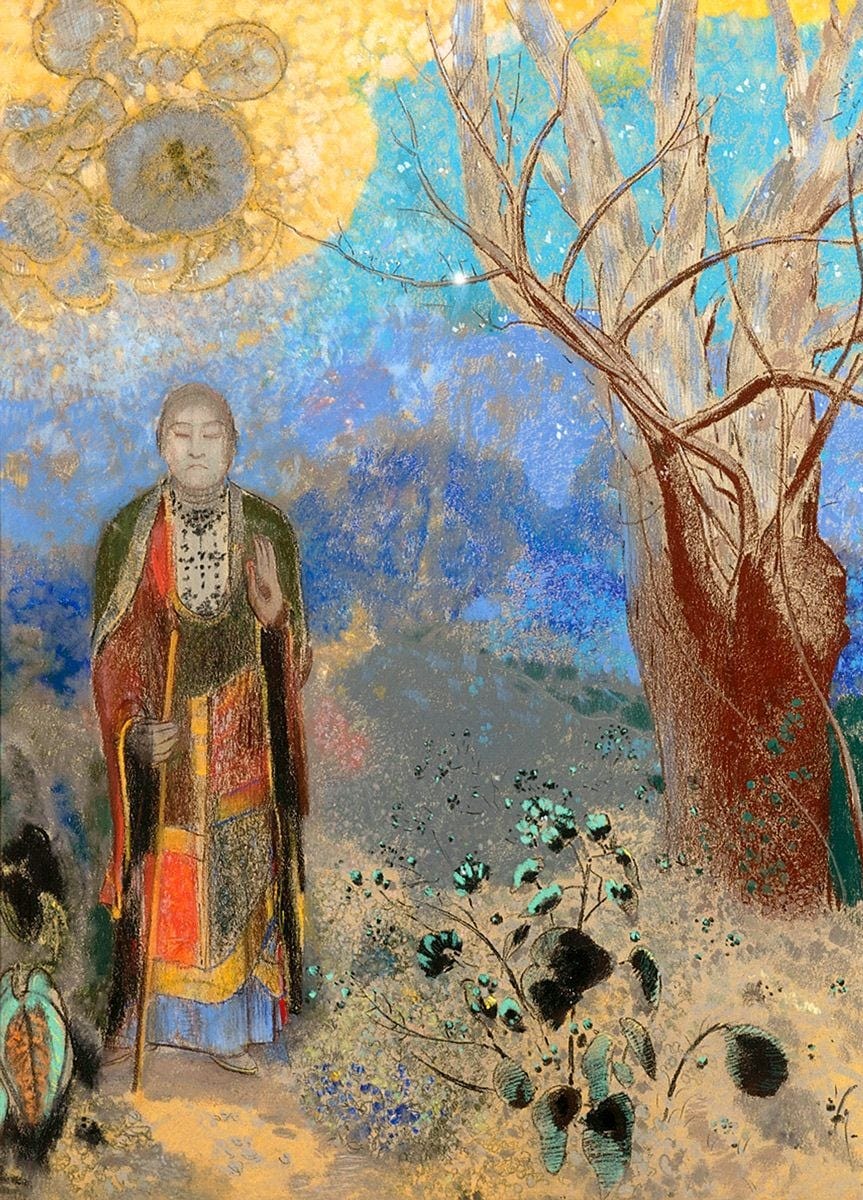
In France, the Symbolists were among the first to absorb these ideas. The painter Odilon Redon created serene Buddhas, floating heads, and charcoal visions that feel suspended between waking and dream states. His imagery reflects a Buddhist‑inflected inwardness, a turn toward contemplation, impermanence and the dissolution of the ego.
This broader European reception sets the stage for the more concentrated and philosophically charged German encounter with Buddhism that followed. German Orientalists such as Wilhelm von Humboldt began studying Buddhist languages and texts in the 1830s, while writers like the Schlegel brothers and later Arthur Schopenhauer helped popularize Indian philosophy among educated Germans. By the 1850s, works like Carl Köppen’s Die Religion des Buddha signaled a growing scholarly engagement with Buddhism, even if filtered through the assumptions and polemics of the time.
It was also in the 1850s that Wagner first encountered Buddhism via Schopenhauer.
Wagner’s reading of Buddhism was, of course, nineteenth‑century and imperfect, a blend of orientalist translations, Schopenhauer’s glosses, and his own mythopoetic imagination. Yet what he absorbed was potent. The Buddhist concept of dukkha, the pervasive unsatisfactoriness of existence, resonated with his growing sense that the heroic will of his early operas was a dead end. In Tristan und Isolde, desire becomes a self-consuming fire; in Die Walküre, Wotan exemplifies the self-destructive nature of power and the failure of intellect. These are not merely dramatic crises but metaphysical ones, shaped by Wagner’s fascination with the Buddhist cycle of craving and release. Tristan und Isolde’s “endless melody” becomes a sonic analogue for samsara, a line that seeks resolution yet continually defers it.
Around 1856, Wagner actually wrote the draft for a Buddhist opera, Die Sieger (“The Victors”). The story, based on legends Wagner read in Burnouf’s Introduction à l’Histoire du Buddhisme Indien, follows the love of Prakriti, an outcast girl, for the monk Ānanda. Despite social and monastic resistance, the Buddha ultimately permits their chaste union and allows Prakriti to join the monastic community, a gesture of compassion and spiritual equality. Wagner never composed music for the work, but the sketch reveals his fascination with Buddhist themes of renunciation, desire, and redemption, as well as opposition to the caste system. Elements of Die Sieger later resurfaced in Parsifal.
Jonathan Harvey’s opera Wagner Dream (2007) is a modern re‑imagining of Die Sieger that moves between Wagner’s deathbed in Venice and the story of Prakriti and Ānanda. Harvey doesn’t try to “finish” Wagner’s opera; instead, he creates a luminous, meditative sound‑world where Wagner’s unrealized Buddhist compassion is finally allowed to unfold, interweaving Western orchestra with live electronics and Buddhist chant.
Wagner Dream Trailer - De Nederlandse Opera
By the time Wagner reached Parsifal, the Buddhist influence had matured into something more substantial. In his book, The Redeemer Reborn, Paul Schofield argues that Wagner, drawing on his deepening engagement with Buddhism, conceived the major characters of Parsifal as reincarnations of the Ring’s protagonists. In this schema, Siegfried becomes Parsifal, Brünnhilde becomes Kundry, Wotan becomes Amfortas, and Alberich becomes Klingsor, each carrying forward the karmic consequences of their earlier actions into a new dramatic cycle oriented toward enlightenment rather than heroic will.
Schofield grounds this in Wagner’s documented interest in Buddhist cosmology and in the abandoned opera Die Sieger, which already explored themes of renunciation and rebirth. He reads Parsifal as the true closure Wagner sought for decades: the reunion of Spear and Grail becomes the metaphysical resolution of the sundered forces that drive the Ring, and Parsifal’s compassion is the transformed, purified echo of Siegfried’s naïve fearlessness.
The opera’s preoccupation with compassion, renunciation and the breaking of karmic cycles reflects Wagner’s reading of the Lalitavistara Sūtra and other early Buddhist texts circulating in German intellectual circles. Parsifal’s enlightenment (his sudden recognition of Amfortas’s wound as his own) is not a Christian miracle alone but a moment of bodhicitta, the awakening of compassion that dissolves the boundary between self and other. Wagner synthesized this with Christianity (which repulsed Nietzsche), but the underlying gesture is unmistakably Buddhist: liberation through insight, not conquest.
Parsifal Montage - Deutsche Oper Berlin
Schopenhauer and Wagner read Buddhism as a metaphysics of pessimism, a world where life is suffering, desire is poison and salvation means extinguishing the will. But in authentic Buddhist teaching, from D. T. Suzuki to Alan Watts to Pema Chödrön, suffering is a starting point for liberation; desire is worked with, not condemned; and the goal is not annihilation but awakening, a clear seeing of reality that produces compassion and freedom. Real Buddhism is experiential, ethical and oriented toward the relief of suffering in oneself and others.
Even for contemporary seekers who follow a more authentic Buddhism, the nineteenth‑century European interpretations still hold real value. They reveal how Western minds first grappled with ideas of impermanence, non‑self and liberation. The Symbolists’ dreamlike inwardness and Wagner’s operatic dramas of renunciation and release all illuminate how Buddhism was refracted through Western concerns. These early interpretations can help today’s practitioners see more clearly what Buddhism is by understanding what it was mistaken for, and, at the same time, give an appreciation for how its core insights proved powerful enough to spark creativity, philosophy and spiritual searching.

Click to purchase
As an Amazon Associate, I earn from qualifying purchases