

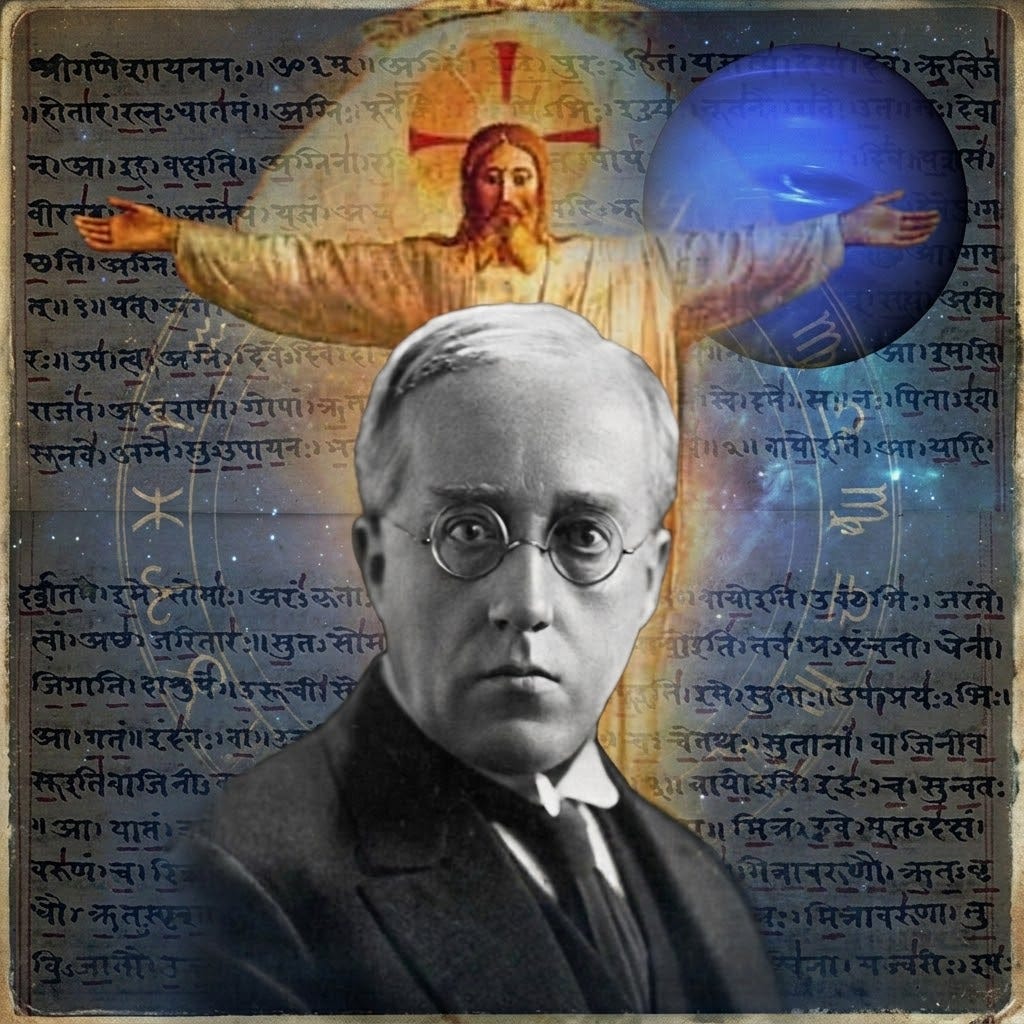
When I first started to listen to classical music seriously, in the early years of high school, I soon discovered Gustav Holst’s The Planets. I assumed the work was inspired by astronomy. But the names Holst gave to the planets, Jupiter, the Bringer of Jollity and Mercury, the Winged Messenger didn’t sound very scientific. But it was a sonic spectacular, and that’s all that mattered to me. It wasn’t until much later than I found out that The Planets was inspired by astrology.
For a long time, The Planets was the only work by Holst that I knew. Then one Christmas night I was listening to KXTR, Kansas City’s classical radio station, and I heard the most unearthly, beautiful work by Holst, which the announcer identified as The Hymn of Jesus. As a good Catholic boy, I recognized the plainchant hymn Pange Lingua that Holst weaves throughout the work. I was infatuated and had to purchase the album. When I got it home and read the liner notes, they said that Holst set a Gnostic text from the Apocryphal Acts of St. John. I had no idea what the word Gnostic meant, but it stuck with me. In those days, we didn’t have Wikipedia so I couldn’t immediately find out what it meant. But the word did stick with me.
Holst’s The Hymn of Jesus performed by the London Symphony Chorus and St. Paul’s Cathedral Coir and the London Philharmonic Orchestra conducted by Sir Charles Groves.
Looking back, I realize that I had stumbled on two of the three great mystical currents that flowed through Holst’s imagination. The first was astrology, which gave rise to The Planets. The second was Gnosticism, which led him to the extraordinary text behind The Hymn of Jesus. The third, Hinduism and Sanskrit literature, I discovered when I purchased an album of Holst’s choral music, which included his settings of Hymns from the Rig Veda.
The Rig Veda settings are important because they reveal what Holst was actually seeking. Reading the ancient Indian texts, he seems attracted less to Hindu doctrine than to a particular spiritual tone: impersonal, cosmic, and ritualized. The hymns are filled with invocations to forces larger than the individual self: dawn, fire, sky, water, creation itself. That same fascination with vast symbolic powers later appears in The Planets, where Mars, Venus, Saturn, and Neptune are treated as archetypal presences rather than physical objects.
Maîtrise of Radio France conducted by Sofi Jeannin performs Gustav Holst's Hymn to Vena from Choral Hymns from the Rig Veda.
Holst was a shy, asthmatic boy, often sidelined from rougher activities, and he spent long stretches of time alone. His solitude inclined him to look inward, and made him comfortable with stillness. For the young Holst, music was a place where the world’s noise fell away. Even his early fascination with folk songs was because of their modal austerity and their ancient connection to the land.
Holst’s first deep encounter with mysticism came through the literature of ancient India. In the 1890s he began reading books on Indian philosophy and poetry, and before long he found himself immersed in the Rig Veda, the Upanishads, and the great Sanskrit epics. Unlike many Western artists who treated Eastern thought as an exotic curiosity, Holst pursued it with unusual seriousness, eventually learning Sanskrit so he could read the texts more directly. The result was a remarkable body of work, including the Hymns from the Rig Veda and the chamber opera Sāvitri, inspired by an episode from the Mahābhārata.
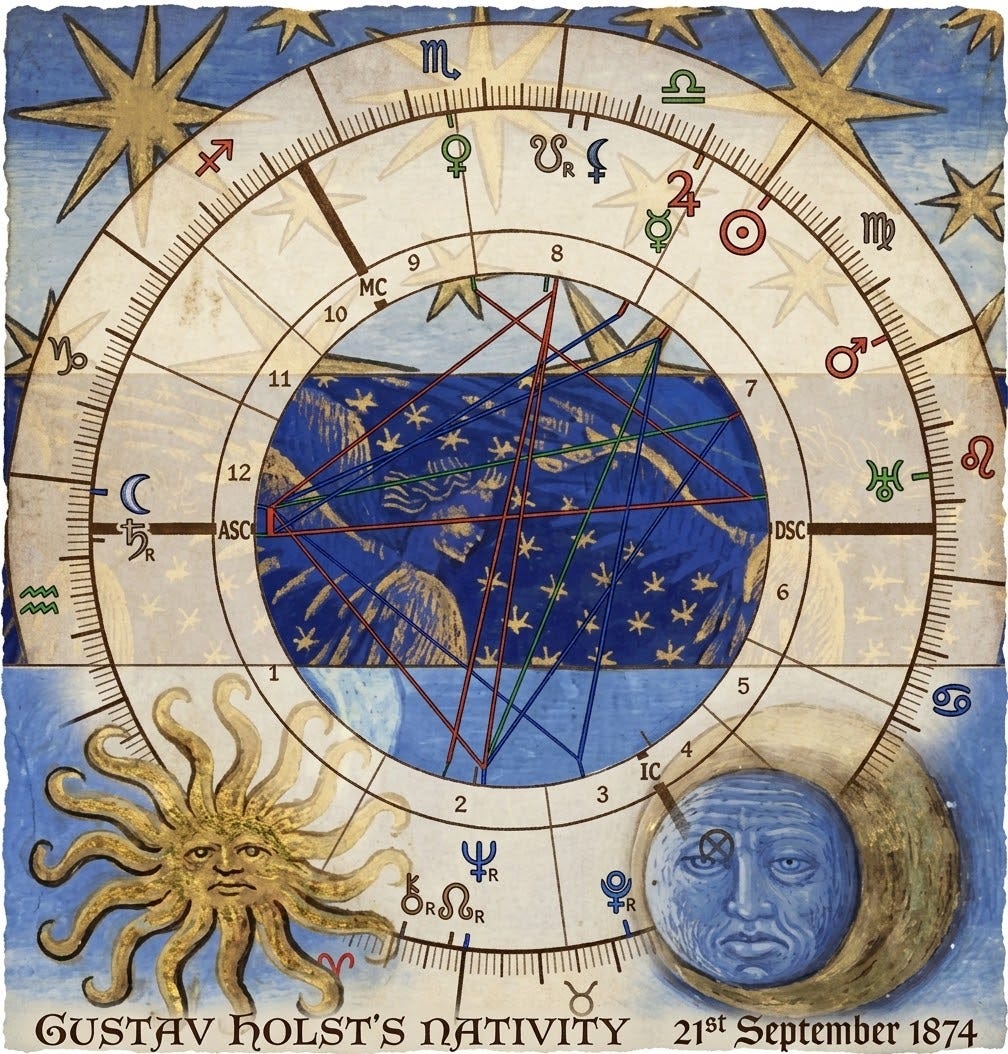
A few years later, Holst developed a serious interest in astrology, which was introduced to him by Clifford Bax, the brother of composer Arnold Bax. He approached it less as a means of predicting the future than as a symbolic language describing fundamental aspects of human character. The writings of the astrologer Alan Leo gave him to a system in which the planets represented archetypal energies rather than simply astronomical bodies. Before long, Holst was drawing up charts for his friends. When he began work on The Planets, he was not composing a musical tour of the solar system. He was exploring Mars, Venus, Jupiter, and Saturn as spiritual and psychological presences.
Gustav Holst’s astrological chart
The last of the three strands arrived during the years surrounding the First World War. Through the scholar G. R. S. Mead, Holst encountered the Acts of John, an early Christian text containing the mystical “Hymn of Jesus.” The imagery of the text, with its cosmic dance and vision of a reality beyond the visible world, immediately appealed to him. Holst transformed it into The Hymn of Jesus, a work whose radiant choral textures and ritual atmosphere remain among the most astonishing achievements in twentieth-century British music. In my opinion, it’s one of the greatest choral works of the 20th century.
But then I’m biased. I can’t say it was because of Holst, but over the years, I also developed a strong interest in astrology, ancient Sanskrit texts like the Bhagavad Gita, and the mystical side of Christianity, whether it be the Neoplatonic writings of Pseudo-Dionysius or Gregorian chant and Gothic cathedrals. So I have a soft spot in my heart for Holst, and I turn to his music whenever I’m in need of his transcendent vision. If you’re only familiar with The Planets, or maybe the wind suites or the St. Paul’s Suite (wonderful works, by the way), you might explore the lesser known spiritual side of Holst for a journey even beyond our solar system.


