By Hilary Larkin
Special to KC Arts Beat
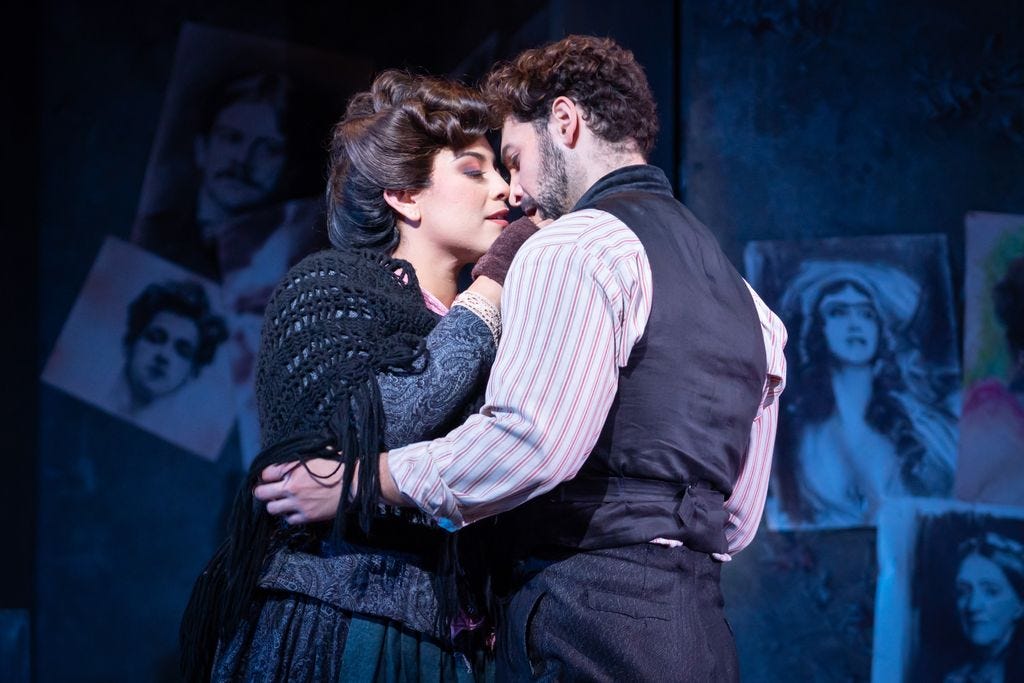
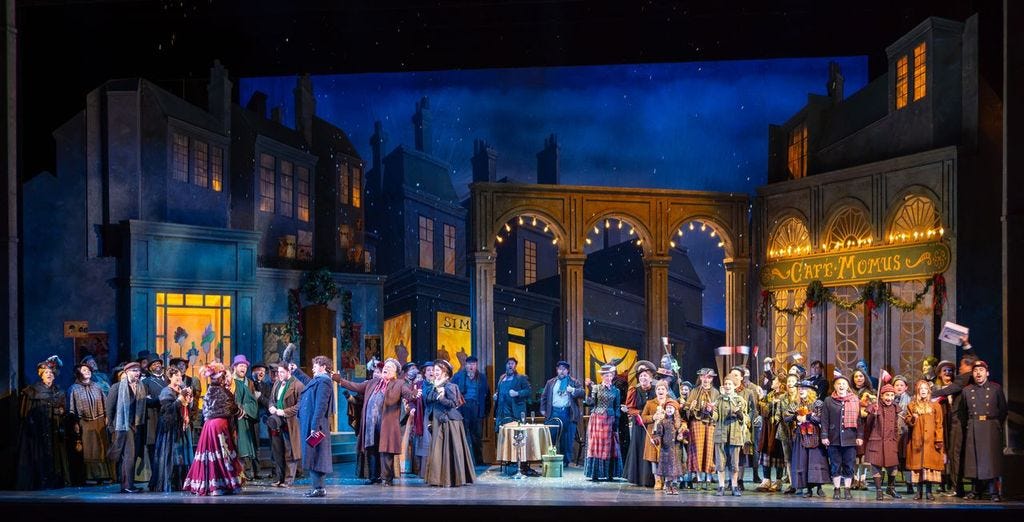
The Lyric Opera’s 2026 season opened with an engaging production of Puccini’s La Boheme, directed by Garnett Bruce and conducted by Christopher Allen. What do we want from a classic opera we’ve seen many times? We do, of course, want the familiar comforts of staging, and we got it—a picturesque Paris in the dim lamplight, a claustrophobic Christmas street scene, the Café Momus cheerily lit, not to speak of the aesthetically-pleasing poverty of the archetypal artist’s garret which anchors scenes of both romance and death. Ideally too, we appreciate something that feels fresh too in the production values, some layer that is brought out in an especially interesting way, that makes us consider the work from an angle. By this measure, the first night of Boheme was enjoyable.
I say enjoyable, for all that it is one of the most tear-inducing works in the genre, because one of the strengths of this production was to interleave the tragic with a buoyant sense of comedy. It’s possible in some productions to feel the comic tinged by the presentiment of disaster, and spend one’s time waiting for the blow to fall, but directed by Bruce, the comic scenes stood out in their own right.
In particular, the all-male scenes in the garret (the openings of Act I and Act IV) were delightfully staged and deftly choreographed, with much knockabout fecklessness, fast-paced pranks, and stage business in abundance. Jose Simerilla Romero (Rodolfo), Luke Sutcliff (Marcello), Raul Morales Velazco (Colline) and Jon Dirk Ross (Schaunard) were a highly believable and endearing quartet of bohemians, whether blandishing the landlord, staging mock battles, munching baguettes, downing wine, or stealing each other’s blankets. They were cheerily unserious about their poverty, half-in-earnest about their art, eternally earnest about their pretenses.
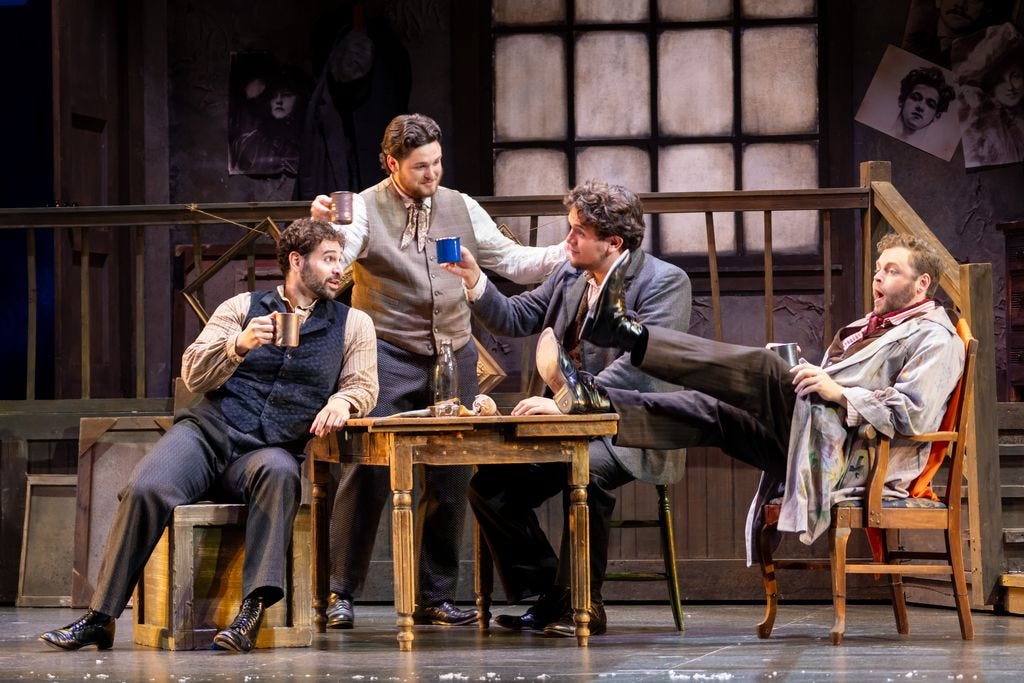
The orchestra led off and kept up a zesty pace for these scenes, picking out instrumental lines precisely, adding an edge, underlining a joke, heightening a moment of play, stabbing a jagged pause into the merriment, so that it seemed as if the instruments themselves were part of a conversation that was intimate, fraternal, and built on all the long associations of camaraderie. The whole set-up was pacey and so funny as to make the first-night audience laugh repeatedly. It did make the gravity harder to come by early on (exacerbated by what seems like a recent trend for audiences to laugh aloud at lines that aren’t supposed to be funny at all – but who are we to judge?), but we got past the candle-fumbling and the knowing ironies into the terrain of deeper emotions. We have to be allowed to feel them if it’s going to mean something at all.
Gabriella Reyes was a lovely Mimi—her voice as healthful and bright and powerful as her character was increasingly ailing. We suspend our disbelief most willingly in favor of a voice with such an easy theater-filling expansiveness. Jose Simerilla Romero as Rodolfo may not have quite matched her in vocal power this evening; but it was a voice of clarity and emotional intelligence, nonetheless. And it felt like both lead singers probed their characters’ souls to convey themselves in those aching duets.
‘I am the poet’ he sings ‘she is the poetry’. But he may be flattering himself: was his poetic drama on Ancient Rome really any good? Probably about as uninspired as Marcello’s never-ending canvas on The Crossing of the Red Sea. Not a loss being consigned to the fire. Mimi’s first aria, artlessly describing her own response to her aloneness, looking out on the roofs and the sky of her native city—may be the stuff of real poetry, the unassuming here-and-now of real life that the male artistes are so very good at avoiding. Their here-and-now is what you play with, trip over, work around, not what you do serious art about. And yet. In coming into their world, she teaches them more about art (and its connection with life and death) than they could have imagined.
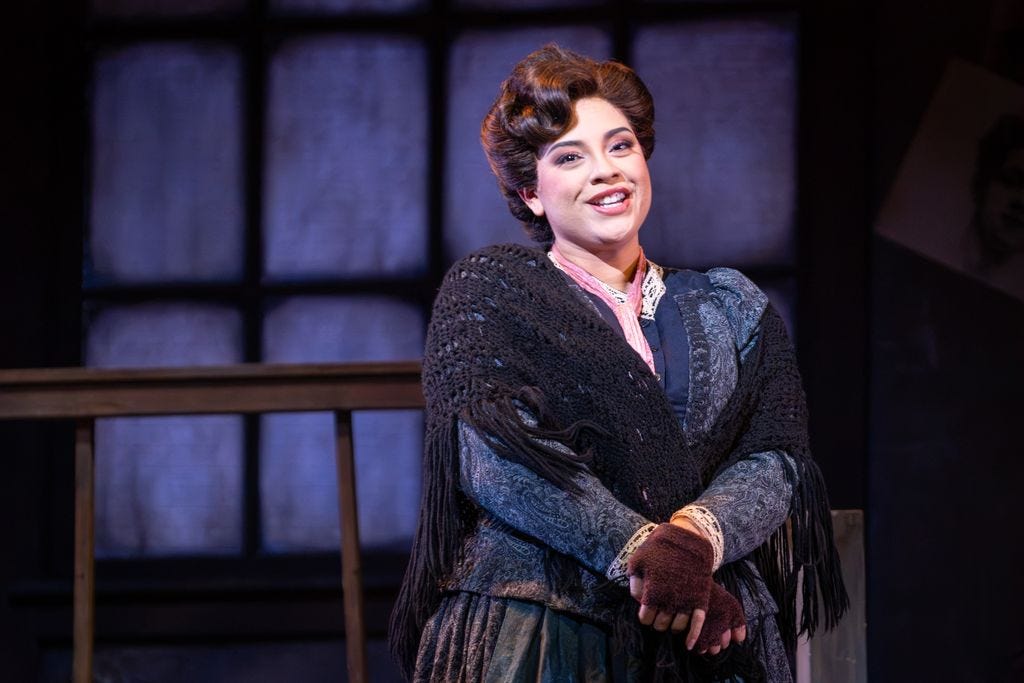
Luke Sutclifff was extremely well-cast as Marcello: a powerful baritone that carried serious weight and projected power and passion. Cadie J Bryan as Musetta had an electric light of a voice, an instrument she could use so dramatically to manipulate others. Her command of stage in her famed Act II aria was just what it should have been: a vivacious piece of theater, conveyed with lots of panache. The audience loved it.
Surely, one of the most striking things about this opera is the juxtapositions it forces on our ear (and heart). That Act II scene layers Musetta’s coquetry, with Mimi’s sincere pity for her plight, Schaunard’s and Colline’s cynicism, Marcello’s increasing desperation. Later in Act III, we have a duet of the separating lovers (Rodolfo and Mimi), behind which is layered a duet (if one can call it that) of the angrily sundering lovers (Musetta and Marcello). And musically, these juxtapositions were conveyed very effectively this evening.
Only in Act IV, in the shadow of oncoming death, do all these juxtapositions fade away, as the cynics and airheads unite around the dying Mimi, emulating her sincerity and purity of vision. Colline’s decision to pawn his overcoat for the cause was freighted with the power of a sonorous bass voice. Musetta’s flouncy soprano became a restrained, refined prayer for mercy. It was moving, this transformation of voices and styles. Finally, there’s no more playing at life: they are all desperately earnest about living—and what it would take for Mimi to live—money, medicine, a muff? Of course, it’s too late for this to be of use. But as we pan out into the last tableau, detailed artistically in Bruce’s hands, we see what Puccini saw: the whole ensemble as a finally finished artwork. In short, the real stuff of poetry.
There are two more performance: 7:30 PM Sept. 25 and 2 PM Sept. 27, Muriel Kauffman Theatre, Kauffman Center for the Performing Arts. For tickets and more information, 816-471-7344 or kcopera.org