

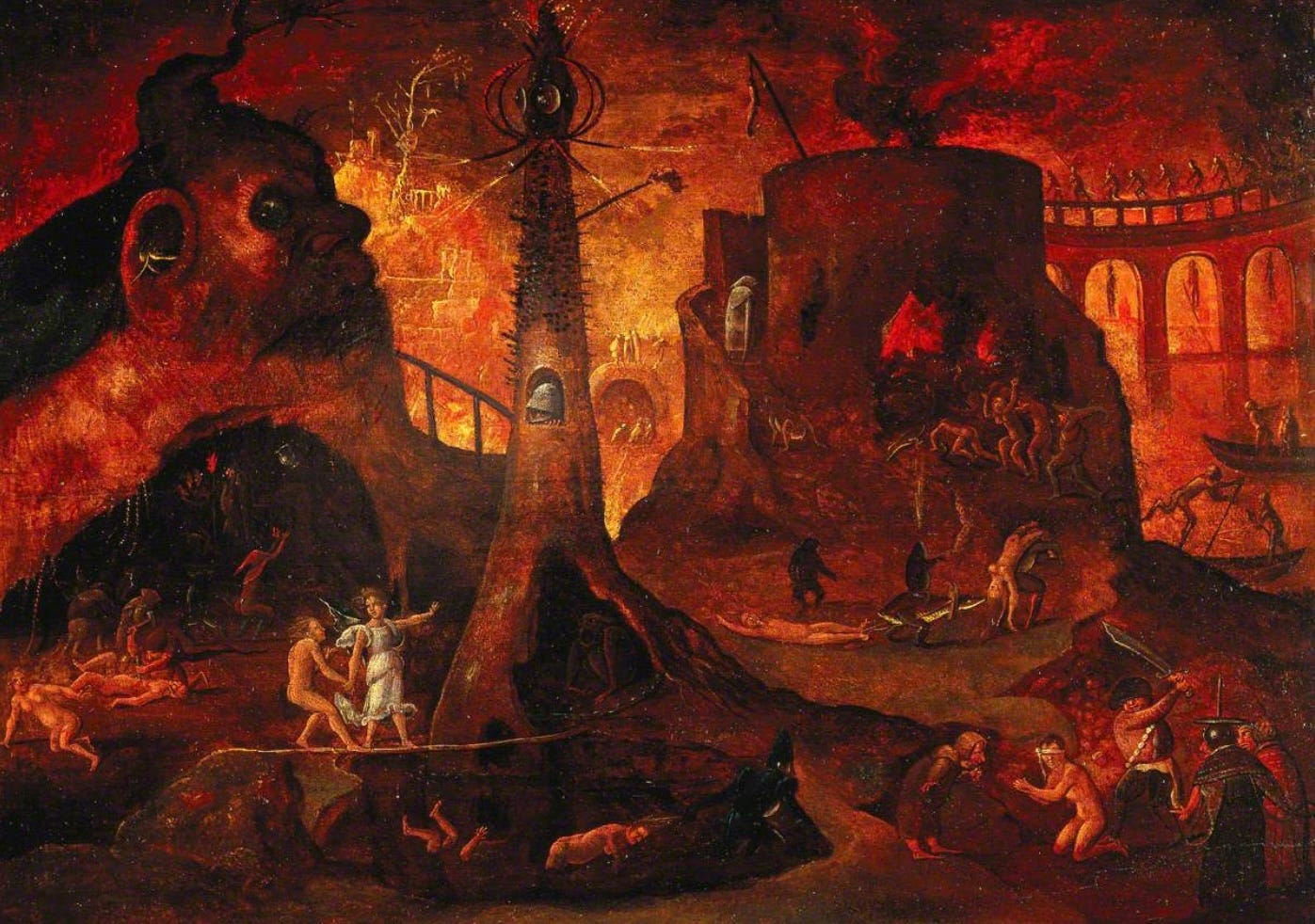
Wildfires are raging, torrential rains are flooding the rivers, melting glaciers are inundating coastlines and heatwaves are baking the landscape. Demonstrations, often spiraling into violence, are convulsing Europe, while nuclear powers rattle their sabers and threaten the world with annihilation. And on the horizon looms a technology far more intelligent than any human being. Will this entity be friend or foe? Will it help solve the problems that have plagued humanity for millennia or will it be our undoing?
Talk about your Age of Anxiety.
In these scary and foreboding times, the medieval chant Dies Irae resonates more than ever.
Dies iræ, dies illa,
Solvet sæclum in favilla:
Teste David cum Sibylla.Day of wrath and doom impending!
David’s word with Sibyl’s blending,
Heaven and earth in ashes ending!
This sequence, or hymn, was part of the Catholic Requiem and All Soul’s Day Mass until it was deleted from the Roman Catholic liturgy after Vatican II because it was deemed too negative. The Catholic funeral Mass has became more a rite of canonization than a memento mori.
But the Dies Irae chant, with its ominous melody and apocalyptic lyrics, has inspired countless composers and still sends a chill down the spine as it makes surprising appearances in the soundtracks of some of today’s most popular films.
The origin of Dies Irae is shrouded in mystery. Some say it was composed by St. Gregory the Great, the 7th century pope who gave his name to Gregorian chant, others say it was written by the 12th century mystic Bernard of Clairvaux. It is sometimes attributed to the 13th century Dominican cardinal Latino Malabranca Orsini, who was noted as a composer of ecclesiastical chants and offices. But it is most commonly credited to Thomas of Celano.
Thomas (c. 1185 – c. 1265) was an Italian friar who was a contemporary and early follower of St. Francis of Assisi. He helped spread the Franciscan movement of voluntary poverty and simplicity to Germany, and was very highly regarded. Pope Gregory IX commissioned Thomas to write one of the first biographies of St. Francis, Vita Beati Francisci (”The Life of Blessed Francis”). More than 700 years after his death, Thomas was beatified in 1991, the first step on the road to canonization.
It has not been definitively proven that Thomas wrote the Dies Irae, but that does seem to be the general consensus nowadays. No matter who wrote it, the funeral chant is saturated with the Medieval Catholicism that also informed Dante’s “Inferno.” The Dies Irae evokes the Last Judgment as depicted in Hans Memling’s famous triptych of the same name.
Mors stupebit, et natura,
Cum resurget creatura,
Iudicanti responsura.Liber scriptus proferetur,
In quo totum continetur,
Unde mundus iudicetur.
Iudex ergo cum sedebit,
Quidquid latet, apparebit:
Nil inultum remanebit.Death is struck, and nature quaking,
All creation is awaking,
To its Judge an answer making.
Lo, the book, exactly worded,
Wherein all hath been recorded,
Thence shall judgement be awarded.
When the Judge his seat attaineth,
And each hidden deed arraigneth,
Nothing unavenged remaineth.
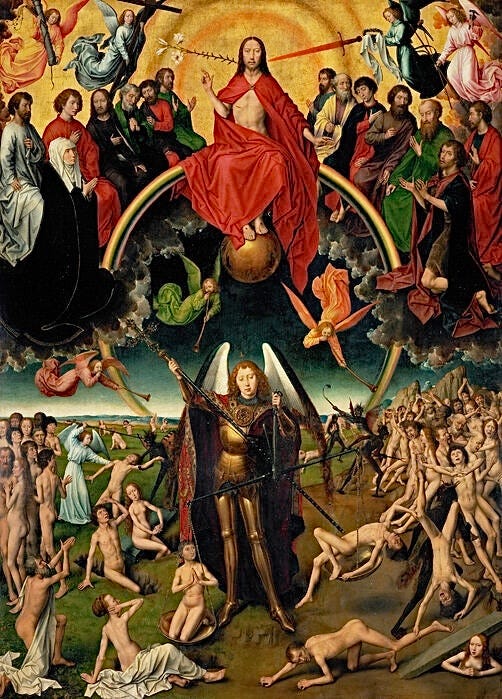
The hymn goes on to depict the separation of the sinners from the saved.
Inter oves locum præsta,
Et ab hædis me sequestra,
Statuens in parte dextra.
Confutatis maledictis,
Flammis acribus addictis,
Voca me cum benedictis.
Oro supplex et acclinis,
Cor contritum quasi cinis:
Gere curam mei finis.With Thy sheep a place provide me,
From the goats afar divide me,
To Thy right hand do Thou guide me.
When the wicked are confounded,
Doomed to flames of woe unbounded,
Call me with Thy saints surrounded.
Low I kneel, with heart’s submission,
See, like ashes, my contrition,
Help me in my last condition.
A Gloomy Tune Composers Love
With its gloom and doom connotations, the plainchant melody of Dies Irae has served as musical shorthand whenever a composer wanted to inject an ominous mood into one of his works. The earliest example of a composer directly quoting the plainchant theme is Charpentier’s 1670 Prose des Morts. The tune can also be heard distinctly at the beginning of Haydn’s Symphony No. 103 “Drumroll.”
It was Hector Berlioz who first used the Dies Irae theme most effectively. The finale of his Symphony Fantastique concludes with a frenzied Dream of a Witches Sabbath that turns the Catholic hymn into an exhilarating Satanic anthem.
Berlioz’ Witches’ Sabbath at the BBC Proms 2019 // Aurora Orchestra
Tchaikovsky wove the Dies Irae theme into his Manfred Symphony, the Orchestral Suite No. 3 and other works. But the composer who was perhaps most drawn to Dies Irae was another Russian, Sergei Rachmaninoff. Although a Russian Orthodox Christian, Rachmaninoff was under the spell of this Roman Catholic hymn. He quotes it in his Piano Concerto No. 1, Symphony No. 1, Symphony No. 2, The Isle of the Dead, The Bells and Rhapsody on a Theme by Paganini. It shows up in other of his works, as well.
Other Musical Settings of Dies Irae
Besides utilizing the plainchant theme of the Dies Irae, composers have composed their own musical settings of the hymn. The film “Amadeus” depicts Mozart dictating his Dies Irae from his deathbed to the composer Antonio Salieri. Mozart’s creative genius is on full display in his setting. From Tuba mirum (”Hark, the trumpet”) with its solo trombone to the pounding Confutatis (”From the accursed”), Mozart finds a way to elucidate and underline the meaning of every verse.
One of the most dramatic settings of Dies Irae is by Giuseppe Verdi. According to musicologist Gundula Kreuzer, Verdi’s contemporaries considered his Requiem “an opera in ecclesiastical robes.” Verdi’s thundering Dies Irae can almost make one feel the earth quake and see graves open in anticipation of the Last Judgment. Done right, the listener should be thoroughly frightened and shaken to the core. Verdi knew what the Dies Irae was all about, and he made it as devastating as any tragic scene in any of his operas.
Gabriel Fauré was put off by the hellfire and damnation of Die Irae and did not include it in his comforting Requiem, which he described as “a lullaby of death.” However, Fauré did find in the ashes of Dies Irae one verse which he decided would be appropriate for his gentle Requiem. It’s the last two lines of the hymn.
Pie Jesu Domine,
Dona eis requiem. Amen.Lord, all-pitying, Jesus blest,
Grant them Thine eternal rest. Amen.
The Pie Jesu is some of Fauré’s most heart-breakingly beautiful music. Other composers who have composed memorable settings of Pie Jesu include Maurice Duruflé, John Rutter and Andrew Lloyd Webber.
VOCES8 performs Pie Jesu from Fauré’s Requiem
The Dies Irae in Films
Ask the average American movie-goer about the Dies Irae, and you’ll likely get a blank stare. Even though most people might not have a clue about the rich musical history of this medieval hymn, its doom-laden melody has made a powerful contribution to some of Hollywoods’s biggest hits.
Perhaps the most famous cinematic use of the Dies Irae is in Stanley Kubrick’s The Shining, based on Stephen King’s horror novel. But that’s just the beginning. The haunting melody can also be heard in the scores for Ingmar Bergman’s The Seventh Seal, Friday the Thirteenth and Tim Burton’s The Nightmare Before Christmas.
But it’s not just in horror films where the Dies Irae can be found. It can also be heard in Star Wars: A New Hope, the TV series Game of Thrones and the Christmas classics It’s a Wonderful Life and Home Alone. It even makes an appearance in Bill Murray’s comedy classic Groundhog Day and the Disney films The Lion King and Frozen II.
While it might be easy for 21st century sophisticates to dismiss the wailing and gnashing of teeth depicted in the Dies Irae, and although its hell-fire theology might be distasteful to today’s feel-good Christians, there is still something very potent about the sentiment and symbolism of this dark Medieval hymn. It has the same compelling and cathartic effect as Gothic rock or the films of David Lynch. It seems that the Dies Irae will continue to exert its power until the Day of Doom.