

By Vern Barnet, Special to KC Arts Beat
Kansas City is fortunate this season to hear all 32 of the Beethoven piano sonatas. Before comments about the first performance in the series of eight evenings, let me remind you of some problems in climbing this mountainous musical terrain.
First, consider problems the performer faces in designing such a series. At the outset, abandon any plan to play them in numerical or compositional order: some sonatas run about 15 minutes; one can take three-quarters of an hour. How do you design evenings of roughly equal length? Should you include a work in a minor key? Or a sample from each of Beethoven’s three “periods”? How do you balance any audience preference for a variety of moods? How do you decide on musical intensity, tonal variety, and the audience ability to absorb the music in any sequence? Do you highlight the musical architecture or focus on the dramatic experience of each evening? Some of these works are among the most technically demanding in piano literature; knowing your own capacities, how do you plan an interesting program and survive -- technically and emotionally?
Second, the audience also has problems, depending on familiarity with the music. If you have heard only one pianist play your favorite sonata, you have the eternal problem of being open to another interpretation. I have over a dozen recordings of the “Hammerklavier.” John O’Conner plays the third movement in 14:44 and Edith Vogel in 23:53. I think both extremes are worthy interpretations. Among recorded and live performances, I have heard only one that was not worth the time. Beethoven seems inexhaustible; shame on you if you try to box him up. For any attending who know Beethoven only through orchestral works, chamber music can be a challenge. Listen not for symphonic proclamation but for intimate conversation. Be open to surprise. Hear the composer as a human being in playful delight, in struggle, discovering, reaching. No matter how universal the sonatas may seem, they are personal in a way the symphonies are not.
For both performer and audience, the stamina brought to a survey of these sonatas can spread into sublime surprise.
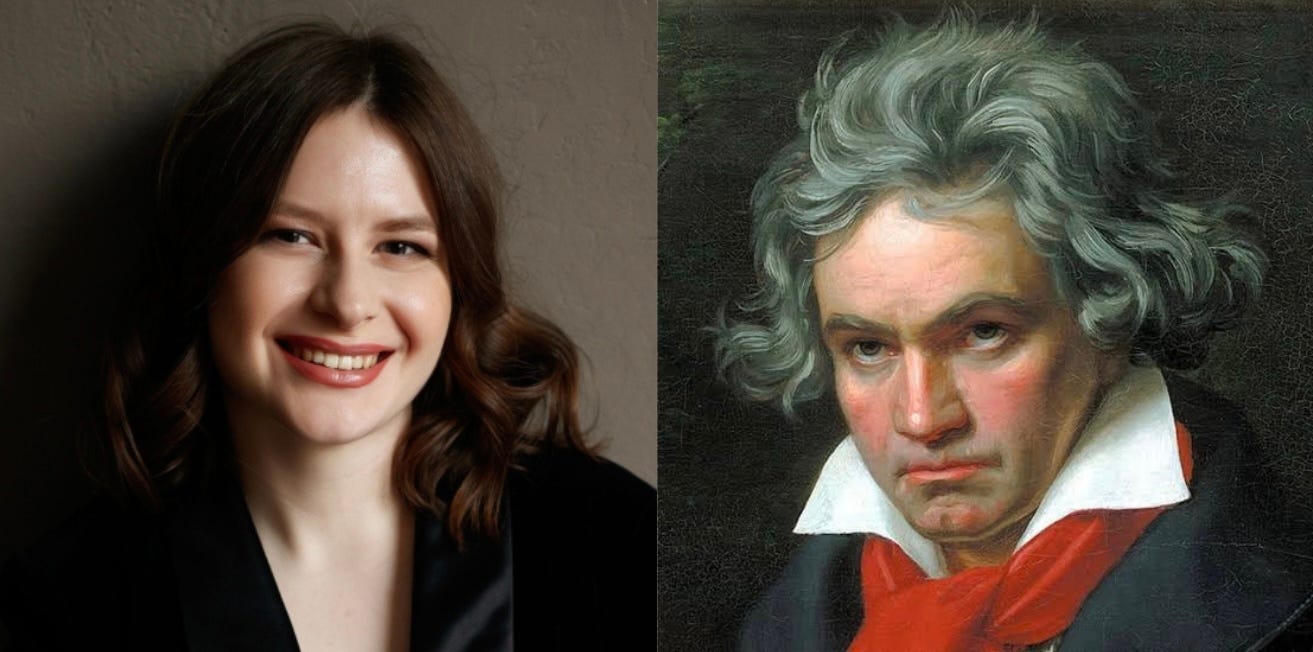
What pianist accepts such challenges? Tatiana Dorokhova, a student of master teacher Stanislav Ioudenitch, presented five pieces November 11 at the 1900 Building to a very appreciative audience November 11. The program listed Nos. 1, 8, 6, 13, and 26. The popular name for Sonata No. 8, “The Pathetique,” was not included; nor was No. 26 identified as “Les Adieux.” Perhaps that was a deliberate invitation to set aside preconceived notions of how they should sound.
The evening began with Sonata No. 1. Nobody can argue with that! Beethoven wrote this in 1795 and it was dedicated to Haydn. To my ear, the wit in this piece was perhaps a bit overshadowed by a touch of Beethoven’s later more romantic impulse. I wondered if I was bringing my own preconceived notion of dynamics to the third movement, but I must say Dorokhova’s version of the last movement perfectly captured the drama of the piece. It was an auspicious beginning to an evening conveying her love of Beethoven. I do think she gave us more of Beethoven’s wit in No. 6. The last work on the program was No. 26, written by 1810, and its cheerful lingering, then sudden, “Goodbye” was the perfect way to conclude this first evening.
Dorokhova brings to Beethoven the ability to project a full dynamic range and impressive technical ability overall to present Bethoven to anyone with an ear to hear. I’m eager for the next performance, December 3.
For tickets to all of Dorokhova’s upcoming Beethoven performances, visit 1900bldg.com/all-events