


I am way overdue in reviewing of one of the greatest classical releases of last year: Warner Classics’ Aldo Ciccolini: Complete Recordings. This monumental 60-CD set reveals a pianist whose identity cannot be reduced to his famous advocacy of French repertoire. It shows a musician of astonishing breadth, capable of moving from Bach’s complex architecture to Mozart and Schubert’s classical lyricism, from Liszt’s transcendental romanticism to the intimate, perfumed world of Déodat de Séverac and his contemporaries. What emerges is not a specialist but a complete pianist: intellectually lucid and emotionally direct,
Ciccolini was making his Bach recordings around the same time Glenn Gould was making his. I love Gould’s approach, and in many ways Ciccolini’s isn’t that different. Ciccolini avoids Romantic heaviness and has a wonderful instinct for line and counterpoint. But, unlike Gould, he brings to Bach’s music a singer’s sense of breath. In the Two and Three-Part Inventions, his articulation is clean without being brittle, which gives the music a quietly human presence rather than making it sound like mechanical piano exercises.
And who knew, but Ciccolini is a superb Mozart pianist. In the concertos and solo works, Ciccolini balances elegance with a subtle dramatic tension. There is grace without fragility. His touch is luminous, never percussive, and he shapes melodic lines with a vocal sensibility reminiscent of his approach to French mélodie. This affinity is also what made Ciccolini a superb accompanist. His recordings with singers such as Nicolai Gedda and Mady Mesplé display a rare combination of sensitivity and poise. His playing breathes with the voice, supporting without ever overwhelming, and that same instinct for lyrical phrasing informs his Mozart. The result is playing that feels poised but never precious, elegant yet alive.


As an Amazon Associate, I earn from qualifying purchases
Ciccolini also had an incredible feel for Schubert. He keeps Schubert’s sometimes wayward sonatas under control, while letting their proto-romantic lyricism emerge. In a way, he is the ideal Schubert pianist, a classicist with an expressive streak.
Liszt, by contrast, is a full-blown romantic, whose music reveals Ciccolini’s command of color and rhetoric. He was one of the great Lisztians of the twentieth century, and the box set preserves performances that combine virtuosity with poetic inwardness. The Années de pèlerinage glow with atmospheric detail; the Harmonies poétiques et religieuses unfold with a meditative intensity that avoids both bombast and sentimentality. Ciccolini’s Liszt is neither showman nor ascetic: he finds the mystical core of the music, shaping it with a painter’s sensitivity to light and shadow, and, when necessary, he brings the drama.


Debussy occupies a central place in Ciccolini’s recorded legacy, and the box set captures the full range of his approach to this elusive composer. His Debussy is neither misty nor mannered; instead, he emphasizes clarity of texture and the underlying harmonic logic. In Images, Estampes, and the Préludes, he brings out the music’s iridescence without blurring its contours, allowing each piece to emerge as a finely balanced study in color and atmosphere. What distinguishes Ciccolini’s Debussy is his refusal to treat the music as impressionistic vapor. He reveals its architecture, its bones, while still letting it shimmer. The result is Debussy that feels both sensuous and lucid, grounded yet weightless.
I was introduced to Ciccolini when I used to work at KXTR, Kansas City’s classical radio station. In the library were well-worn vinyl albums of Ciccolini playing the Saint-Saëns piano concertos (included in this set, by the way, and sounding great in remastered sound) and several albums of the music of Eric Satie, the composer with whom Ciccolini is perhaps most intimately associated.
He recorded Satie’s complete piano works twice, and both cycles are included here. The contrast between the two is illuminating. The earlier recordings have a youthful freshness, tempos are slightly brisker, the humor maybe slightly more subtle, the lines drawn with a clean, almost neoclassical pen. In the later cycle, the Gymnopédies and Gnossiennes have a more introspective glow, and the eccentric miniatures—Embryons desséchés, Sports et divertissements—are shaped with a gentle, affectionate irony. In both sets, Ciccolini captures the whimsy when appropriate and treats Satie’s Zen-like simplicity with the utmost refinement. Other pianists like Jean-Yves Thibaudet have given Satie serious attention, but Ciccolini was the first to give him the respect he deserves and he did it with unmatched musicality.


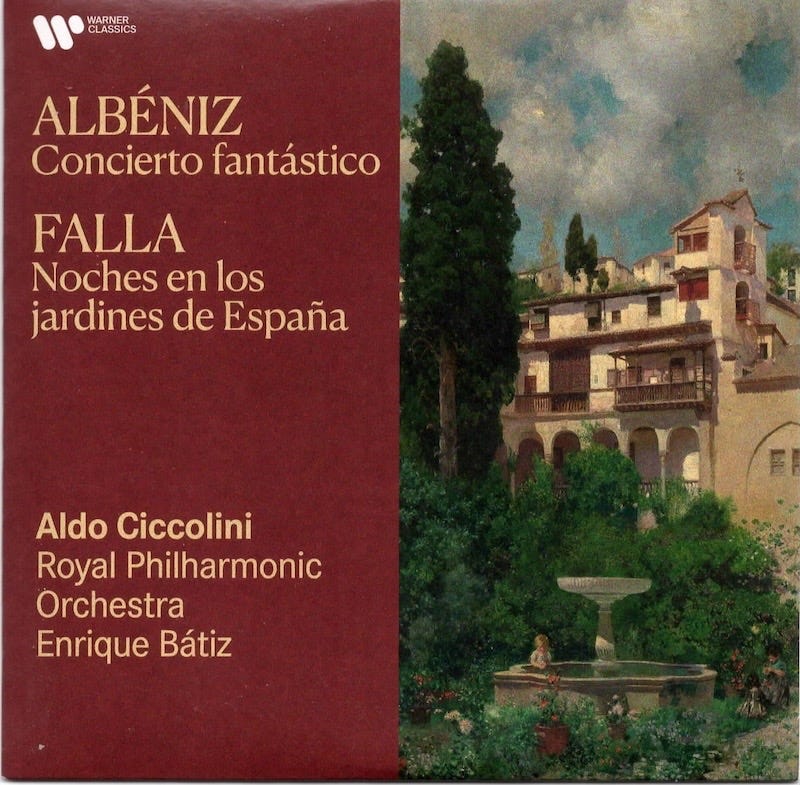
Ciccolini’s Spanish recordings—particularly his Albéniz and Falla—add yet another dimension to his versatility. He approaches Albéniz’s Iberia with a rare combination of rhythmic vitality and refined color, capturing the music’s heat without sacrificing its harmonic perfume. The textures remain transparent even in the densest pages, allowing the inner voices to shimmer like light on tilework. In Falla, Ciccolini emphasizes the music’s ritualistic intensity, bringing out the earthy, flamenco-like quality in works such as El amor brujo and the Cuatro piezas españolas. The Spanish repertoire was a natural fit with Ciccolini’s French and Italian sensibilities.
But it is the French repertoire—famous and obscure—that gives the set its unique identity. His Debussy and Ravel are crystalline and supple, but the real treasures lie in the lesser‑known composers he championed. Ciccolini’s recordings of Déodat de Séverac are revelatory: the Baigneuses au soleil, En Languedoc, and Cerdaña suites shimmer with regional color, Provençale sunlight, and pastoral melancholy. He treats Séverac not as a curiosity but as a major voice, giving the music the same care he brings to Debussy or Fauré. The box also includes luminous readings of Chabrier, Massenet, Pierné, and other composers who rarely receive such devoted attention.

Taken as a whole, the Warner box set is a monument to a pianist who might not leap to mind as one of the all-time great pianists — but should! It’s a portrait of a pianist of rare integrity, curiosity, and imagination. It shows Ciccolini as a bridge between traditions—Italian, French, Germanic, Spanish—and as a musician who believed that beauty, clarity, and sincerity were universal values. Ciccolini is a pianist for connoisseurs, and these are recordings to be savored. I know I will be returning to this set time and time again.

I’ve always considered Gould’s performances of Bach brittle and mechanical. Loved your comment on Ciccolini’s performances of Bach