
LIVING POOR AND SINGING FREE
The Lyric Opera of Kansas City’s “Epic” Porgy and Bess
By Hilary Larkin, special to KC Arts Beat
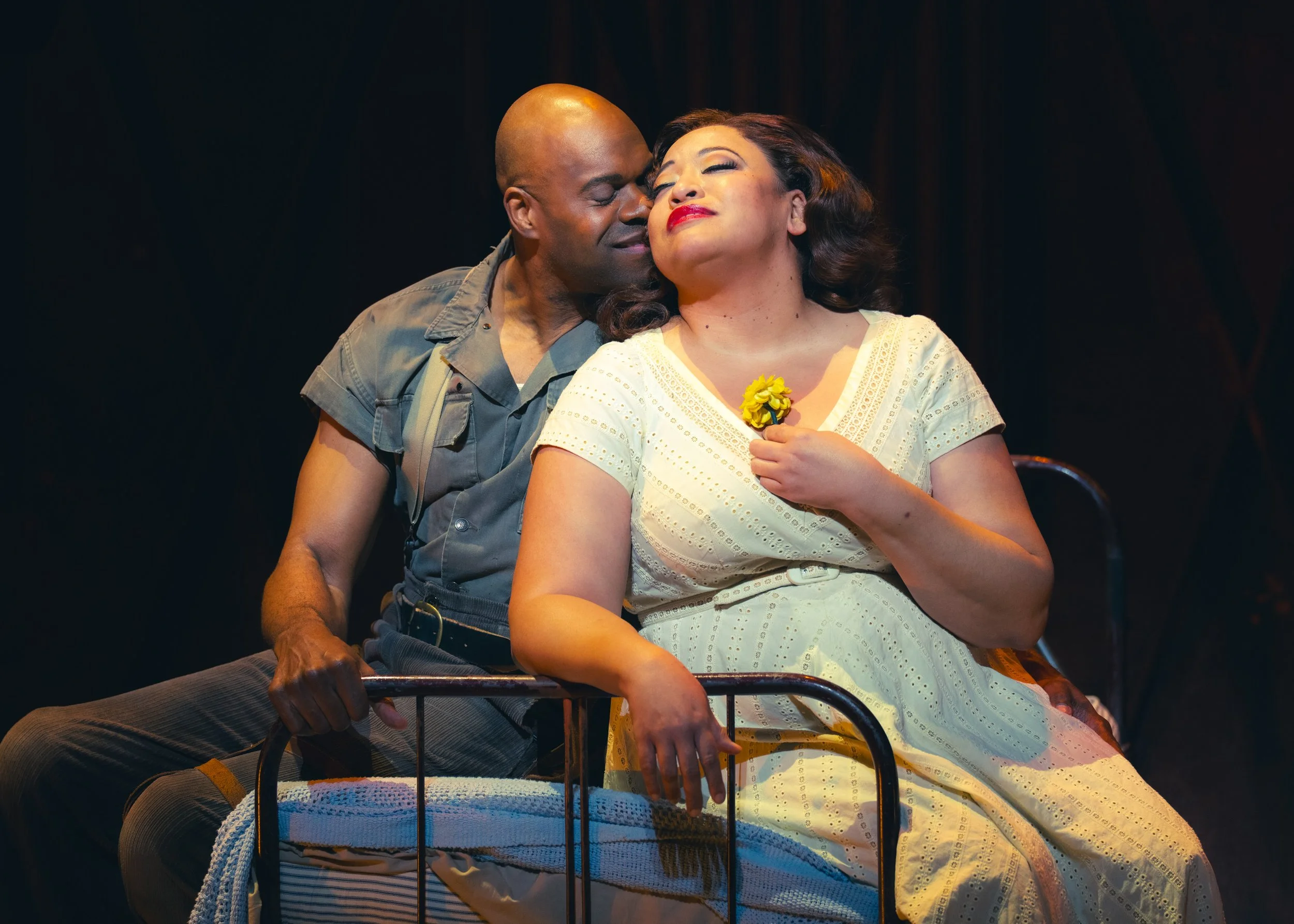
Porgy (Eric Greene) and Bess (Michelle Bradley), Lyric Opera of Kansas City’s production of Porgy and Bess.
Ninety years on, it’s safe to say that the Gershwins’ Porgy and Bess is an operatic classic. Francesca Zambello’s 2026 production for the Lyric Opera of Kansas City, its lustrous score ably conducted by Michael Ellis Ingram and the scenes vividly choreographed by Eric Fogel and Eboni Adams, gave us every reason to think it an epic too. Peter Davison’s sets grounded the whole in a reality that was almost tangible. Catfish Row: dingy and dilapidated , with its rusted, corrugated panels and broken railings, is warmed by sunlight and its people, just as later, it will be shattered by manslaughters, funerals, and storms. The industrial leftovers and railway of Kittiwah island: an oasis only to those whose lives were poor. The voices of the chorus emerged, harmonious, antiphonal, anguished from a realistic environment.
In an opera which plays on the idea of living poor but singing free under the stars and sun, the lighting, arranged by Mark McCullough, became an agent in itself. Particularly memorable was the pathway of light opening from Porgy’s door: his home represents a place of refuge, an escape. In their first encounter, Porgy’s hand, sculpted both in shadow and light, reaches out to rescue Bess—an action of grace in a dark, complicated world. Later, the same golden light is differently modulated when the same door opens up to allow Bess’ return to a decadent life with Sportin’ Life. But we’re not deceived by the apparent glow. The bright lights of NYC are not the same as the sunlight of Catfish Row
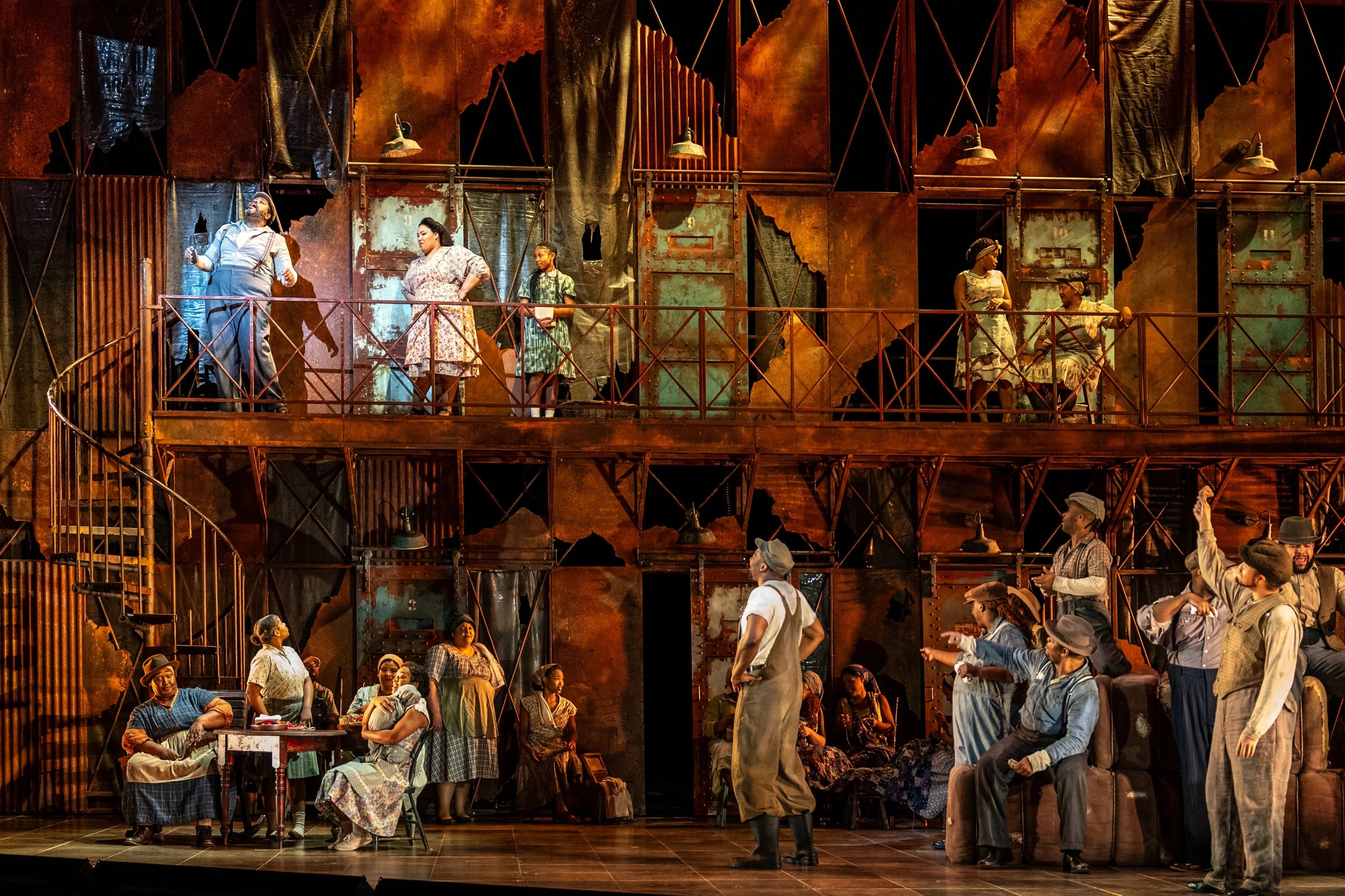
Catfish Row, Lyric Opera of Kansas City’s production of Porgy and Bess
The epic quality of this opera centers around what it means to be a man. Although it’s unstated within the opera, we can imagine the emasculating condition of being born into a racial structure which automatically subordinates black males. Added to that Porgy’s other drama: as a cripple, he is not (conventionally) able-bodied. And yet, we know from the first, from Eric Greene’s deep sustaining tones, that he undergirds the whole community. But what does it mean for Porgy to feel confident in his masculinity? Having a woman. Check. Act I. Killing a man. Check. Act II. Proof to self, to the world: ‘Bess. You got a man now’. Leaving home ultimately, risking all to rescue ‘his’ woman. And that’s where we leave him on the cusp of an Act III which never takes place, limping across the stage on that Odyssean quest, in the glowingly familiar pathway of light. ‘O Lord, I’m on my way’. Whether he succeeds or not doesn’t really matter: he has attained the status of epic hero. Greene made that journey movingly believable.
Bess (beautifully sung by Michelle Bradley) has no initial vulnerability to speak of: she’s sassy, brassy, utterly confident in her sensuality, casually flirting with other people’s husbands. It makes her transformation more striking; Porgy allows her to acknowledge her vulnerability even as he makes her feel safe. The scene where Maria gives Bess a hat for the picnic and calls her sister is a profound indication of her acceptance within the community. What can be more ‘respectable’ than a hat? It’s, of course, ironic that it’s the act of looking for the hat which causes her to get left behind on the island and encounter Crown who proceeds to rape her.
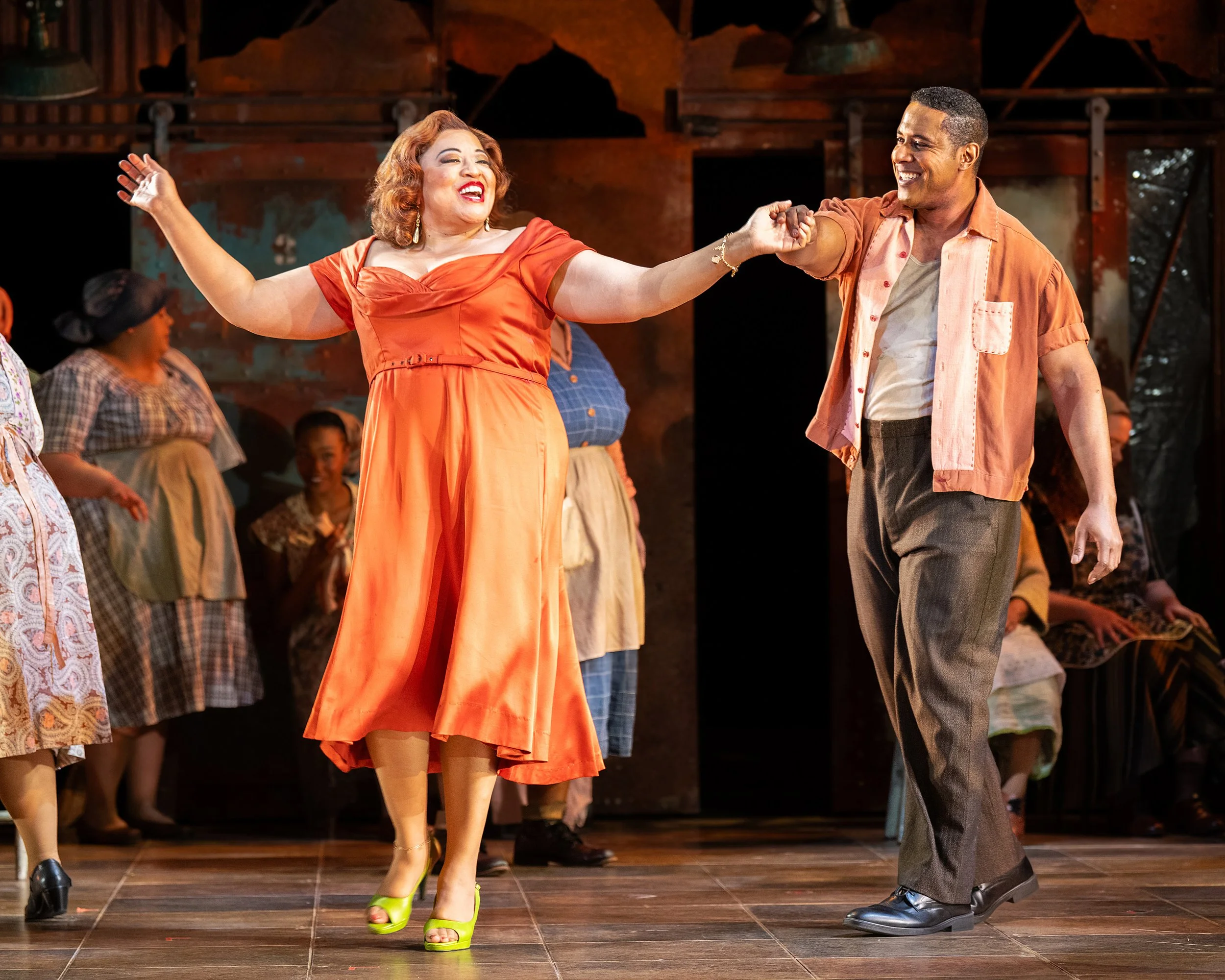
Bess (Michelle Bradley) and Crown (Donovan Singletary), Lyric Opera of Kansas City’s production of Porgy and Bess.
The opera is also concerned with what it is to have faith: from the informal, joyous faith of Porgy who’s ‘got my Lord’ to the passionate moralism of Serena and the Bible worthies, trying to rein in the appetites and lusts of the community. The irreligion of Sportin’ Life (a well-cast metallically-voiced Jermaine Smith) is the counterpart to all of it. From the wonderfully choreographed It ain’t necessarily so to his callous playing of craps while everyone else prays during the hurricane, he is ultimately an anti-social creature who is masterly at using social forms (those dance moves!) to corrupt who he can. Nonetheless, he too has his divinity, a beautifully observed inversion, encapsulated when he raises his arm to lift up the happy dust. The others raise their arms in prayer; his object of worship is dope. Choose your faith. It’s tragic that Bess ultimately chooses his.
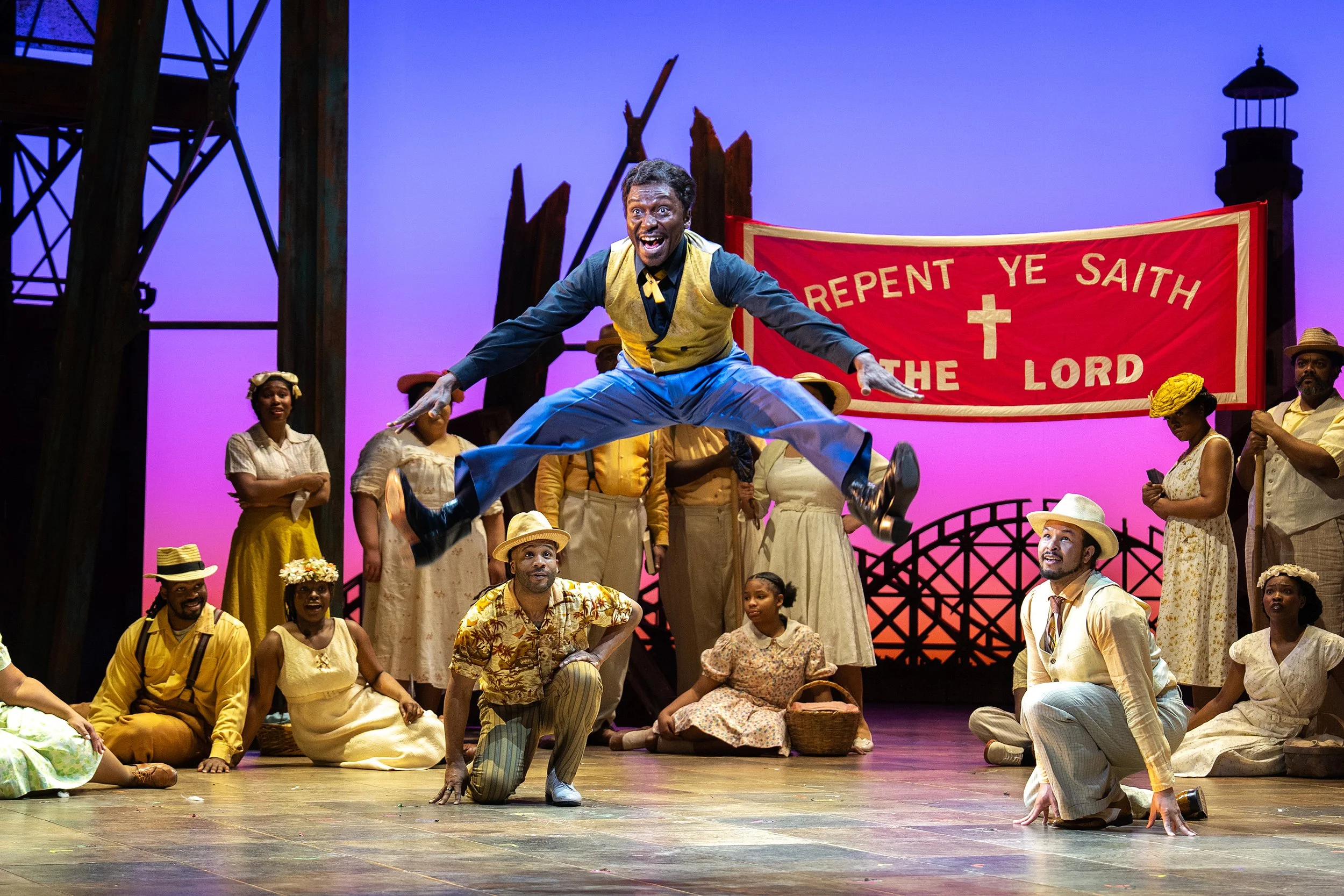
Sportin' Life (Jermaine Smith), Lyric Opera of Kansas City’s production of Porgy and Bess.
Finally, La Shelle Allen’s Maria was an extraordinary presence, whether singing, squawking speaking or silent. Frequently, I found my eyes straying over to her. It wasn’t that she was deliberately drawing attention to herself, but whether cleaving meat, wiping an apron, dusting a chair, conducting purchases, laying Jake’s cap on his coffin, I found that she is the moral heart of the whole work, never idle, always vigilant. She is kindly and protective to insiders (without any of Serena’s heavy-handed religiosity or the occasional fecklessness even of Porgy), but viciously intolerant of those who would destroy the community—Bess initially, Sportin’ Life always, and Crown, whose corpse she disposes of with brisk efficiency.
Maria is the kind of character who’ll never have an opera named for her. But we know that Porgy can’t leave without her blessing, which she gives in wrapping Bess’ dress around his shoulders, a protective shawl. Forget Bess, lovely, flaky Bess, whose voice filled Catfish Row, and the whole theater with ease for a space, but who’ll never come again. Porgy and Maria are the true patriarchs and matriarchs. But he leaves. She stays. Catfish Row got a woman. And this one isn’t just a ‘sometime thing’. Keeping the hearth: I claim that too as an epic act.
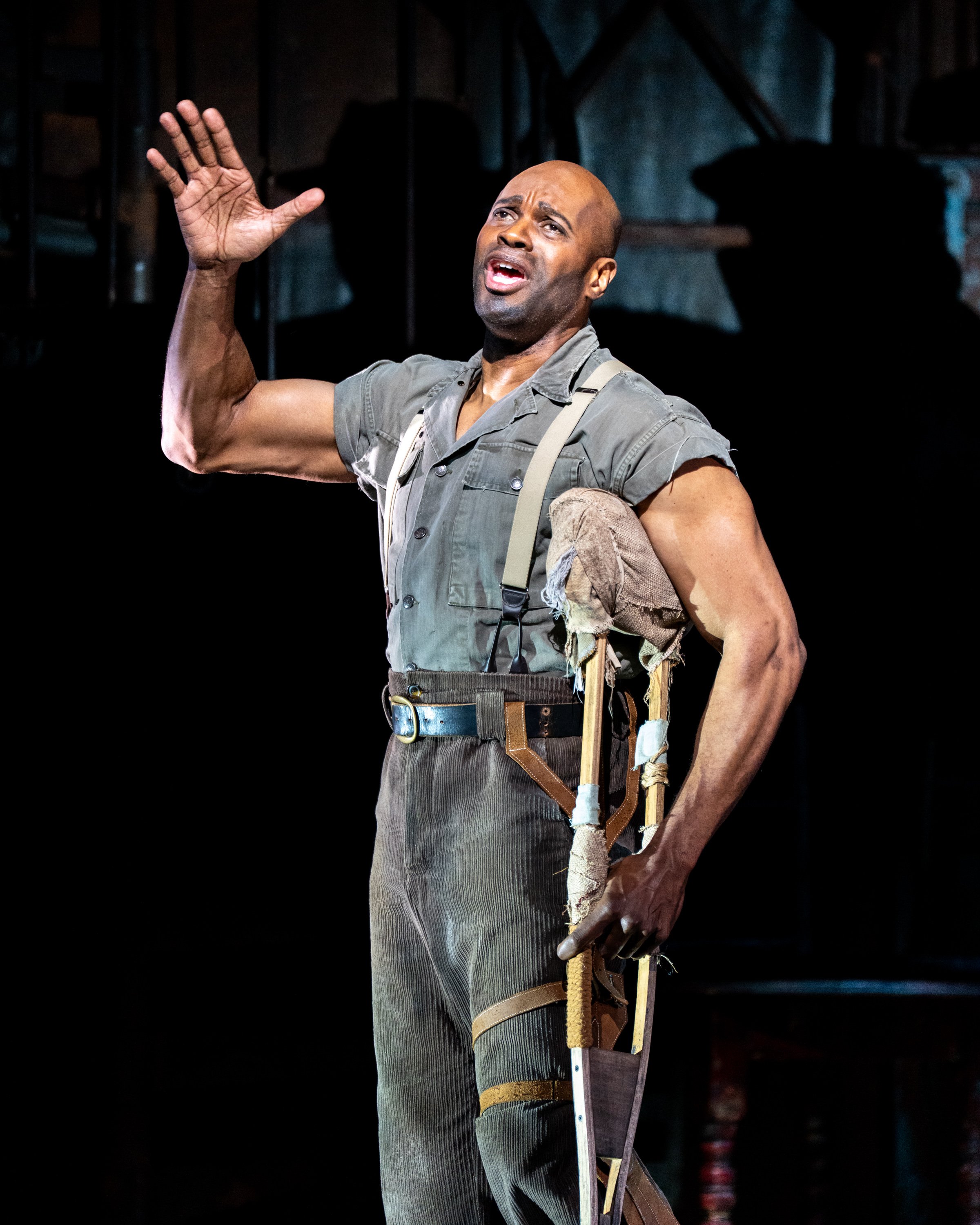
Porgy (Eric Greene), Lyric Opera of Kansas City’s production of Porgy and Bess
Hilary Larkin was born in Dublin, Ireland and currently lives in Kansas City. She has degrees in French and History from University College Dublin and a PhD in History from the University of Cambridge. She has a background in music and drama, and has a teacher's diploma in violin and also in speech and drama from the Royal Irish Academy of Music. She is a free-lance writer, educational consultant and adjunct professor.