
NEITHER HERO NOR ABSOLUTE VILLAIN
Metropolitan Ensemble Theater Presents A Man for All Seasons
By Hilary Larkin, Special to KC Arts Beat
Some theater makes you feel good. Some is supposed to make you feel worse. It uses its evocative power to strip away your illusions, not only about an alternative life on stage, but illusions you might have about yourself and the world you live in (or may have lived in, in another time period). Robert Bolt’s A Man for All Seasons is, in that uncomfortable sense, a classic: a thoughtful person’s piece of theater, one that gets under your skin and remains with you long after the lights go back on and you leave Henry VIII’s troubled London behind you. Under Karen Paisley’s direction tonight, the Metropolitan Ensemble Theater troupe offered us a powerful and emotionally intelligent performance, encompassing all the vagaries of legal, political, theological, and human drama.
There’s a famous portrait of the Venetian Doge Leonardo Loredan by Bellini (1501), whose face has always haunted me. It is the face of a cerebral Renaissance statesman, who has power but is not intoxicated with it: it is restrained, watchful, slightly world weary. That same kind of face and expression was brought to life with remarkable intelligence tonight by Tod Schnake playing Sir Thomas More. Everything about his acting spoke of a character who valued equilibrium. He was elegant and careful in speech, gracious in movement. Although clearly a man of status, he doesn’t throw his weight around, like the powerful others, but there is weight. Compared with it, the blustering of Wolsey (pompous Park Bucker), the volatility of the King (bumptious John Cleary), and the vital energy of Cromwell (Andy Penn) are all patently superficial. The proper exercise of power demands restraint. More’s habitual moderation (even before discretion is forced upon him) make his few outbursts exceptionally powerful. Even well-governed passions must, at times, be released in full force. Schnake’s face expressed all the subtleties: we saw the growing tension in the taut lines around the forehead and lips. It was strangely moving to see such a man completely overcome by emotion when his family visited him in prison.
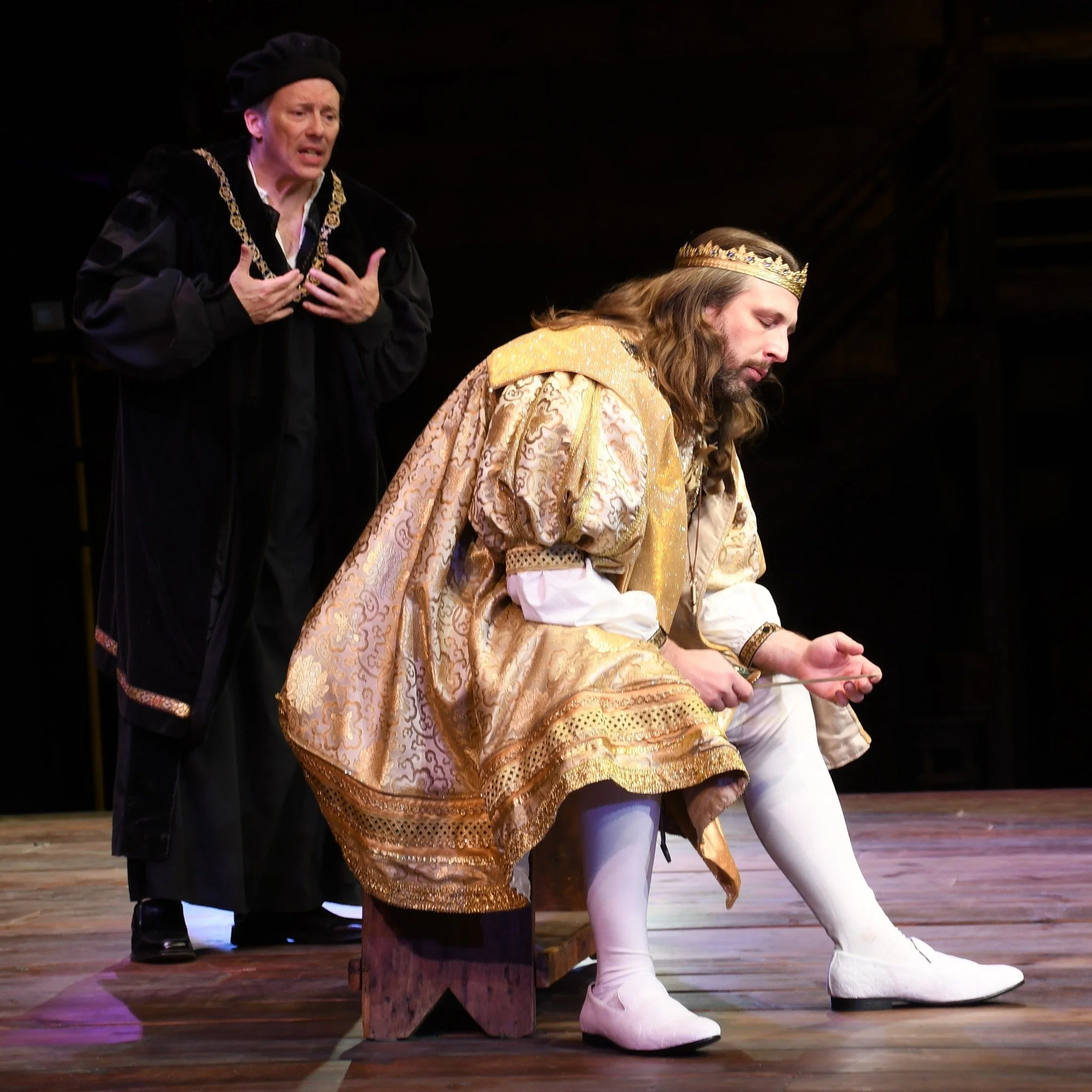
Tod Schnake as Thomas More and John Cleary as King Henry VIII
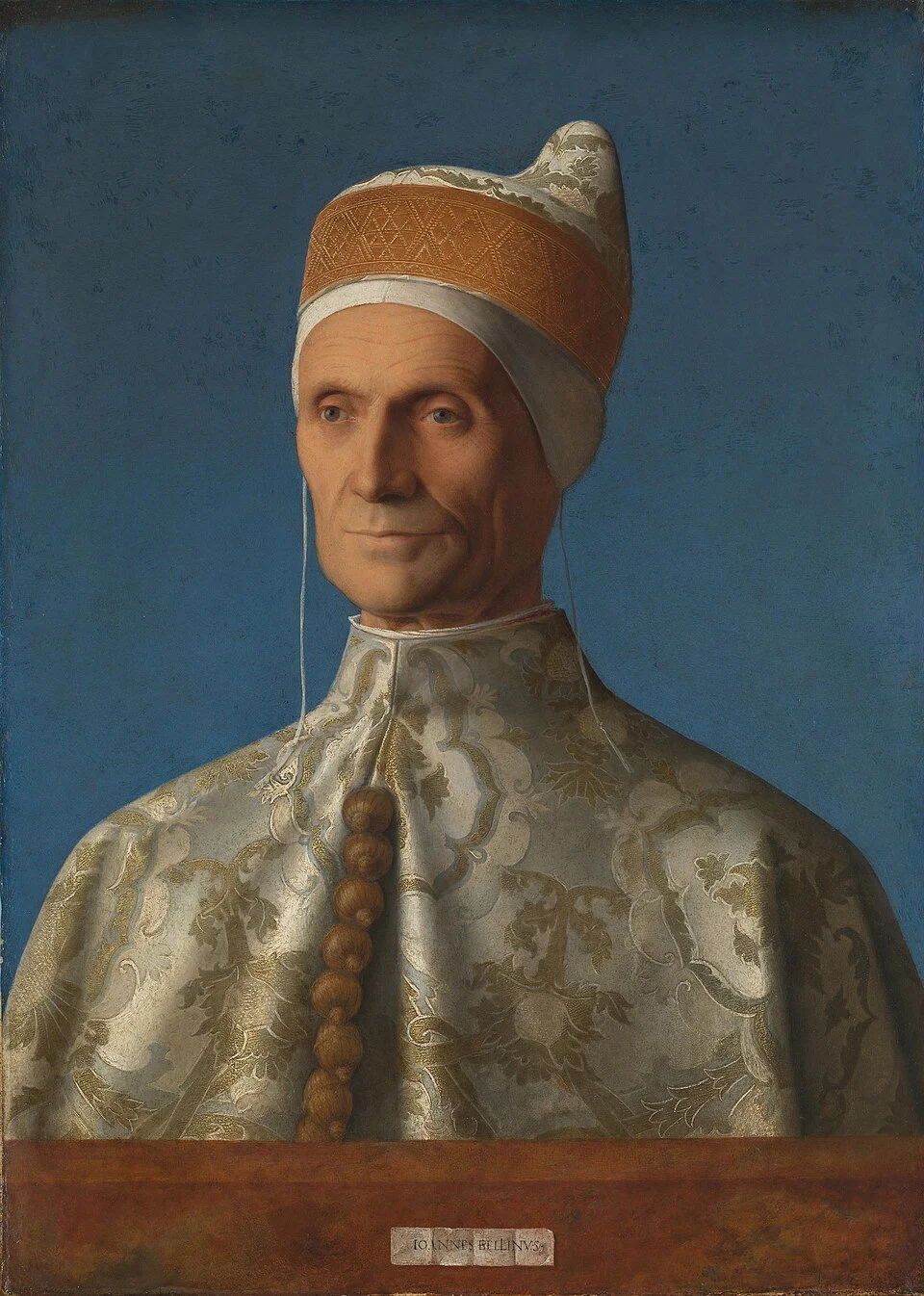
Venetian Doge Leonardo by Loredan by Bellini
The Common Man shares more with More than might, at first, appear. Like More, he too wants to stay in the middle. But his ‘middle’ is entirely pragmatic, flexible enough to allow him divulge secrets to get a reward, but not enough to get into real trouble. It’s very important in a production to get the Common Man right. John Clancy nailed it. Grizzled, disheveled, shabbily attired: he was an apparent nonentity in most scenes, except that he was, also, by the same token, everybody: servant, boatman, publican, spy, gaoler, jury, executioner. And, most importantly and uncomfortably, he’s us too. We’re left with him at the end: we are him. He survives; we survive. We are neither the heroes, nor the absolute villains. We are, after a fashion of speaking, men for all seasons. Clancy gave us that prickly uncomfortable feeling that we were collusive.
I very much enjoyed Andy Penn’s Cromwell. Prepped to hate him, I wasn’t expecting him to be quite so likeably energetic. His villainy was all the more subversive for being so attractive: especially his man-of-the-world laugh. Once again, we felt collusive with the wrong set of people. Pam Schnake’s Alice, meanwhile, was a bustle of good-hearted, simple, cheeky practicality. To be ‘beneath’ the reach of her husband’s intellect makes her a very grounding character. Jessica Schnake as Meg was somewhat too flouncy and jaunty for a sixteenth-century lady raised in refined humanistic culture and in a very particular understanding of the filial relationship (not quite More’s daughter as regards the subtle shadings), but she provided a warm and intelligent presence nonetheless. Hot-headed Roper (Chris Preyer) was suitably loud, suitably boisterous, and as bloody-minded as his father-in-law is restrained. Maytham Thurman as Rich (loved the fuzzy frizz hairdo by the way) was loud and puppyish. I wanted some more ancien regime servility, more tiresome ‘whininess’ from him in the earlier scenes, as he hankers after the long vista of possible promotions. I felt some more emotional complexities from him in later scenes, but still wanted him to be more legible (however that might play out or be expressed) in that very last encounter with More. It’s a remarkable Judas/Christ, Brutus/Ceasar moment really: the confrontation of treachery in a friend. Rich doesn’t reply to More’s mellow and ironic sally, but we want to read something in his face: inscrutability, horror, rage, deadness, even that prickly uncomfortable feeling of being found out.
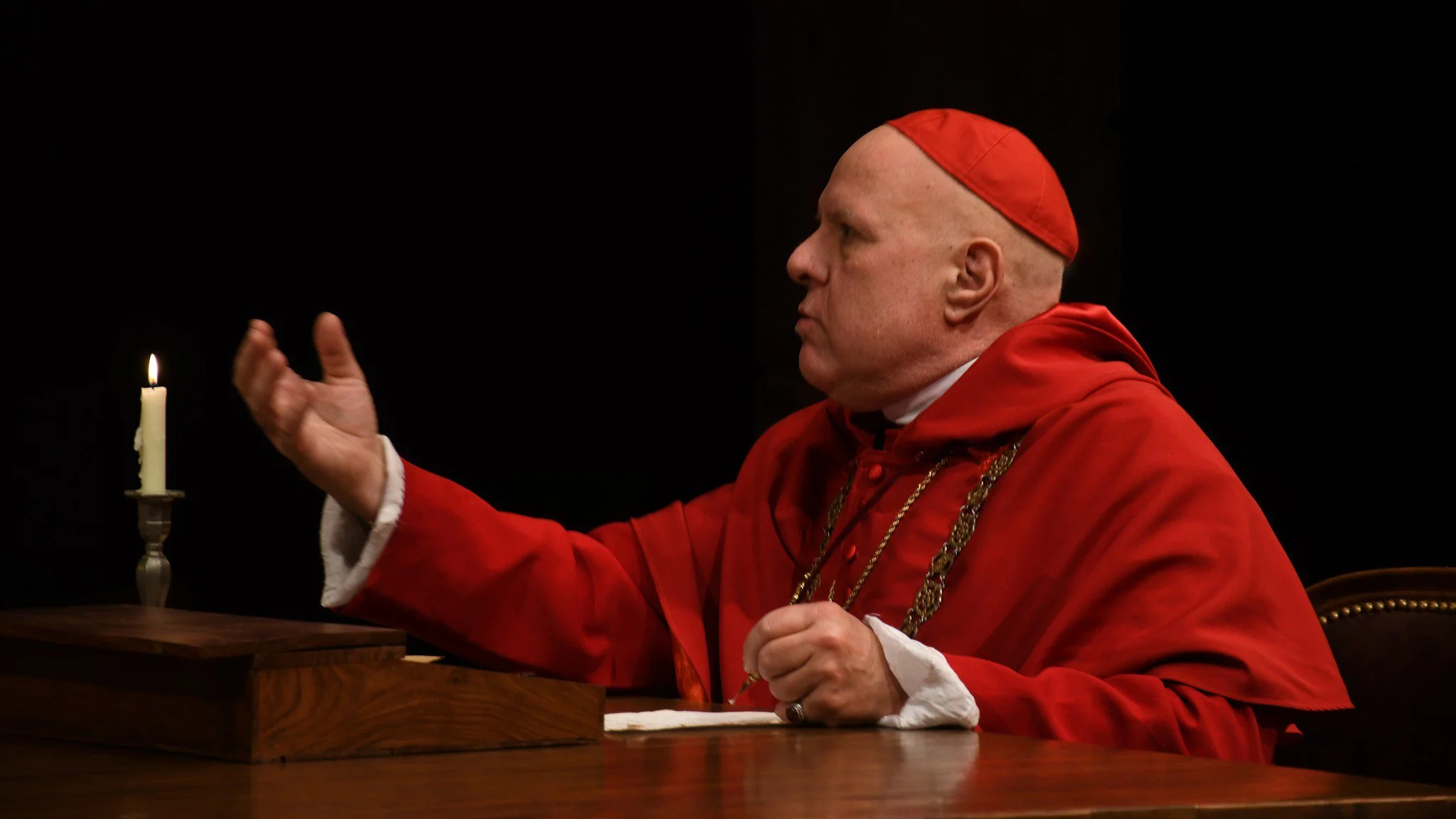
Park Bucker as Cardinal Wolsey.
This is a drama about words and ideas, about the self and selfhood. We don’t need elaborate staging. We shouldn’t be distracted. A lot can be done with little. Larissa Wratney as stage manager and her team understood this and made some good choices. Benches, chairs, tables, writing materials, tankards, bundles of firewood, inn-sign, steps. Small adjustments (e.g. the addition or removal of a tablecloth, the change of clothing fabric from linen to silk or velvet) to indicate rise (or fall) of status. It suffices.
Early on, most endearing of all, there was a touching scene on the Thames, a humane little encounter between More and the Common (boat)man. The mime of rowing felt real, and we could see the scene in our mind’s eye. ‘Whoever makes the regulations doesn’t row a boat’, Common man grouches (he could have been a London cabbie). More nods with wry understanding. And there they are both together, in their different ways, great man and mediocrity, rowing on, as best they can, under the constraints of rules they didn’t make. It’s a lovely moment. They are in the same boat. If there’s any comfort in the play, this is it.
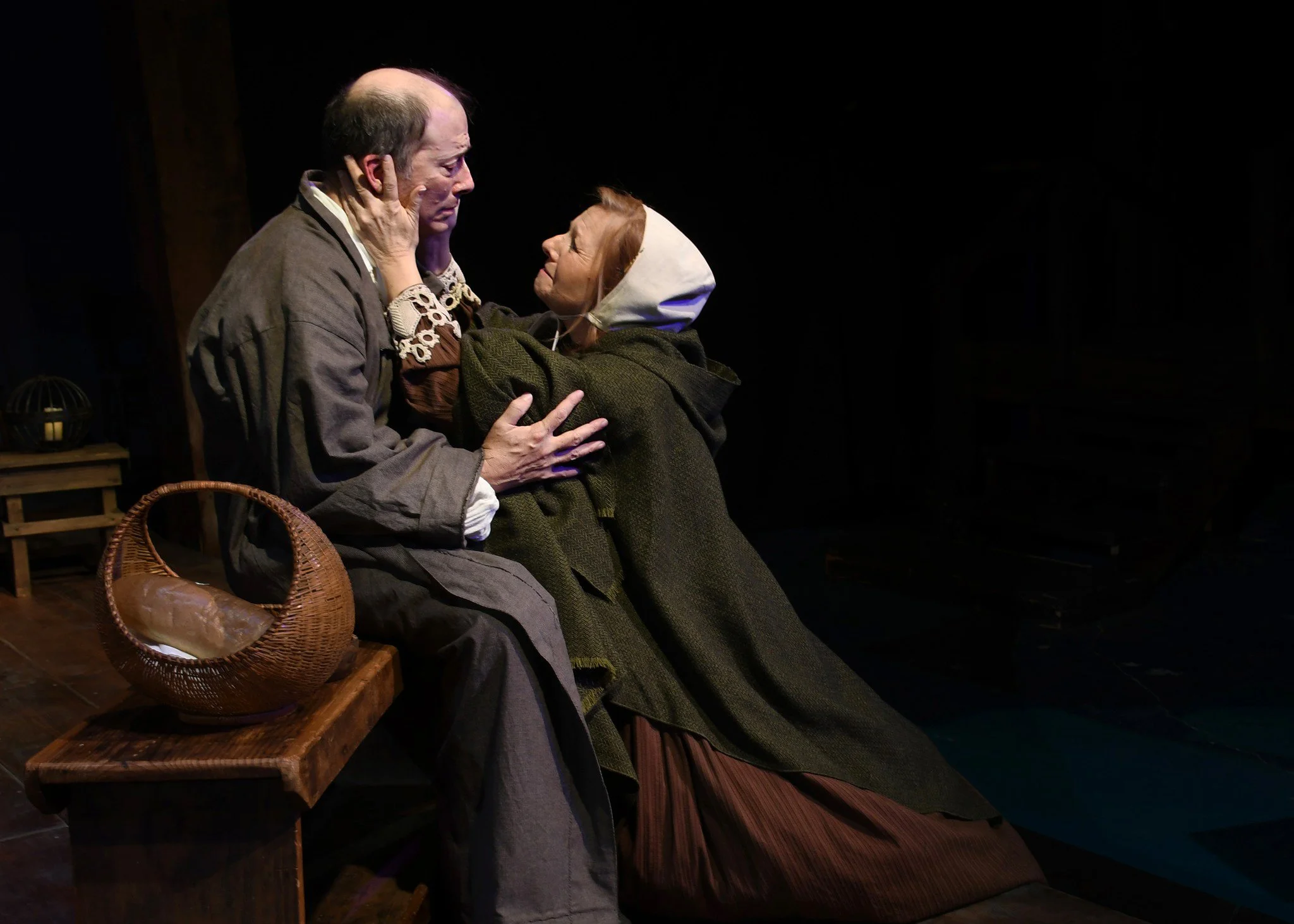
Tod Schnake as More and Pam Schnake as Alice
For more information about Metropolitan Ensemble Theater, www.metkc.org